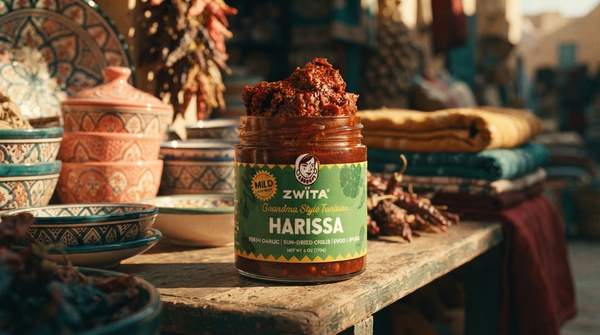
Harissa is a Tunisian invention, full stop. The fiery red paste was born on Tunisia's Cape Bon Peninsula, built around chili peppers that only arrived in North Africa in the 16th century, and in 2022 UNESCO inscribed not just the condiment but the whole body of knowledge and social practice around it on its Representative List of Intangible Cultural Heritage. If you've seen jars labeled "Moroccan harissa" and wondered whether they're the same thing, they're not — and understanding the difference will genuinely change how you cook with both.
Harissa's Global Journey and Tunisian Roots
Here's the thing most spice aisles won't tell you: harissa is as Tunisian as it gets. As Munya, who writes the Tunisian cooking blog Our Tunisian Table, puts it, "If there is one ingredient that is quintessentially Tunisian, it has to be harissa," noting that Moroccans have their own beloved condiment, amlou, while harissa is "trademark Tunisian." Even neighboring Libyans and Algerians — who eat plenty of harissa themselves — acknowledge its Tunisian origins, as the food writer behind the Zwïta blog recounts.
Today Tunisia is the world's biggest exporter of prepared harissa, sold in jars, cans, bottles and tubes, and the condiment has traveled far beyond North Africa into kitchens worldwide. But the version the world knows was shaped by a specific place: the peppers were first grown on the Cape Bon Peninsula, with the city of Nabeul serving as the primary center of production. That geographic anchor matters, because the pepper varieties — and the culture built around them — are what set the original apart from its imitators.
The Historical Tapestry of Harissa: From Chili to Condiment
The story begins with a botanical plot twist. Chilies are native to the Americas and were completely unknown in North Africa before the Columbian exchange. The commonly cited moment for their arrival in Tunisia is the Spanish occupation of Hafsid Tunisia between 1535 and 1574, when Spanish forces controlled coastal strongholds — and, presumably, brought New World peppers with them. It's hard to imagine now, but Tunisian cuisine was absent of chilies entirely before Europeans carried them back across the Atlantic.
The name itself carries an older history. The Arabic verb harassa means "to pound" or "to crush," and the term was originally used for a porridge of pounded wheat, butter, meat and spices dating back to the 7th century. Over time — and this shift is inferred from the etymology and the historical arrival of chilies rather than documented in a single dated record — the word migrated from describing a pounded grain dish to describing the pounded chili paste we know today.
One more layer: from the end of the 15th century, Andalusian Muslims and Jews were expelled from Spain, and many resettled in North Africa, bringing Andalusian culinary sensibilities with them. So the condiment in your pantry is really a convergence of three forces — an American plant, a Spanish occupation, and an Andalusian diaspora — all landing in one small corner of Tunisia.
Harissa's Cultural Heartbeat: A Tunisian Tradition
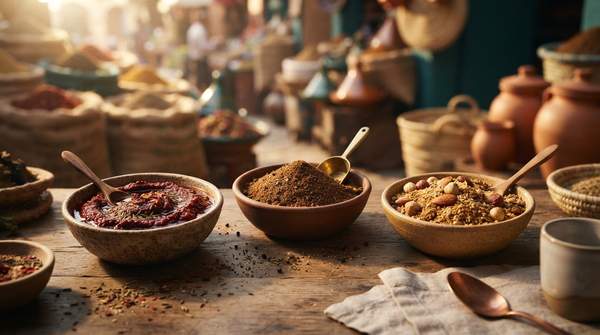
What makes harissa remarkable isn't just its heat; it's how it's made. Traditionally, harissa-making is a seasonal, communal ritual led by women. When the harvest arrives, families and neighbors traditionally gather to prepare chilies in large batches. The chilies are split, seeded, and then sun-dried for days, a process that reduces moisture and concentrates their natural sugars and oils. Once ready, they're washed and ground with garlic and spices — sometimes by hand, sometimes with simple mechanical tools.
The core ingredients are roasted red peppers and the Baklouti pepper, along with garlic paste, caraway seeds, coriander seeds, cumin, and olive oil to carry the oil-soluble flavors. But there is no single canonical recipe: variations depend on household and region, and can include additions like fermented onions, lemon juice, cumin, tomatoes, or even rose petals. In Tunisia, harissa appears at every meal — served as a condiment, rubbed on meats, stirred into stews, mixed into couscous. It’s not reserved; it’s constant.
UNESCO Recognition: Preserving an Intangible Heritage
In 2022, at its 17th session, UNESCO added "Harissa, knowledge, skills and culinary and social practices" to its Representative List of the Intangible Cultural Heritage of Humanity, under Tunisia's name. Read that title carefully: the inscription covers the knowledge, skills and social practices surrounding harissa — not merely the paste itself. That distinction is the whole point of the designation.
What UNESCO is protecting is the seasonal ritual, the women-led transmission of technique, the communal drying and grinding, the agricultural knowledge tied to specific peppers. As Naouel Bouabid, writing for the Tunisian food brand Damya, describes it, harissa "has always been made the same way: together." The recognition formalizes what Tunisians already knew: this is a living cultural practice, not just a product. The video documentation credited to Tunisia's Institut National du Patrimoine captures exactly that dimension.
Comparing Tunisian and Moroccan Harissa
So what should you actually buy? Here is the framework I use, built from the documented differences between the two styles.
| Dimension | Tunisian Harissa | Moroccan Harissa |
|---|---|---|
| Origin & cultural status | The original, born on the Cape Bon Peninsula; a national condiment whose surrounding practices were inscribed by UNESCO in 2022. | Used in Morocco, but not culturally central — Moroccans have their own traditional condiments like amlou. |
| Typical seasoning level | Bold, spicy and aromatic, built on roasted red and Baklouti peppers with garlic, caraway, coriander and cumin; recipes vary by household and region. | Generally less seasoned and less fiery, reflecting a Moroccan cuisine that leans toward sweet and savory flavors — saffron, ginger, cinnamon, dried fruit. |
| Primary use philosophy | A foundational ingredient served with every meal: condiment, meat rub, stew base, couscous mixer. | A more adaptable flavor base — kept milder deliberately so it can be folded into dishes with different flavor profiles. |
The comparison reveals a real philosophical split. Tunisian harissa is the benchmark: intensely seasoned, culturally embedded, meant to assert itself. Moroccan harissa, as the Zwïta blog explains, is intentionally less seasoned so cooks can incorporate it into a wider range of dishes — a starting point rather than a statement. Neither approach is wrong; they're answering different questions.
Choosing Your Harissa: A Culinary Decision
When selecting harissa, consider whether you need a culturally rich, spicy, and aromatic condiment (Tunisian) or a milder, more adaptable flavor base (Moroccan) to best suit your culinary goals. If you want a paste that will carry a stew, season couscous, or stand alone on the table, reach for the Tunisian version with its caraway-coriander-garlic backbone. If you want a gentle chili foundation you can steer toward sweet, savory, or fragrant dishes, the Moroccan approach fits better.
The measurable indicator is simple: check whether the label or description specifies "Tunisian" or "Moroccan" origin, or lists key differentiating ingredients like caraway for Tunisian, or a milder spice profile for Moroccan. That single line of packaging tells you which culinary philosophy you're holding — and whether you're tasting a UNESCO-recognized tradition or its more versatile regional cousin.
Sources
- Harissa - Wikipedia — EN
- Video: Harissa, knowledge, skills and culinary and social practices - UNESCO Intangible Cultural Heritage — ICH
- What on EARTH is 'Moroccan Harissa'? — Zwïta
- Homemade Tunisian harissa — Our Tunisian Table
- The True Story of Harissa — Zwïta
- Harissa: The Soul of Tunisian Cuisine — Damya, Massiva LLC