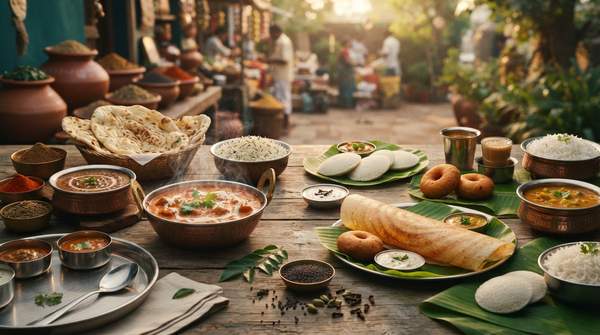
Order "curry" in India and you may get a creamy, yogurt-soured wheat-bread meal in the north — or a tangy, tamarind-laced lentil stew over rice in the south. The single word hides two fundamentally different ways of cooking. North Indian food leans on wheat breads, garam masala, and dairy-driven richness; South Indian food is built on rice and lentils, sambar powder, and the sharp tang of tamarind. Once you can read those signals, you can look at any Indian menu and predict what a dish will taste like before it arrives.
Beyond 'Curry': Understanding India's Culinary Diversity
Here's the thing nobody tells you at the takeaway counter: "curry" isn't really an Indian concept at all. Culinary writers point out that curry powders and pastes, by name, are a Western invention — a time-saving blend meant to approximate the flavors of traditional Indian cooking, not something used in any specific regional cuisine. No cook preparing Indian food in the traditional manner reaches for a generic curry powder.
The word itself carries colonial baggage. The Institute of Culinary Education traces the modern style of curry dishes to the British presence in India, when administrators and their armies adapted local dishes to suit their own palates. What they called "curry" flattened a vast landscape into one label.
And that landscape is genuinely vast. India is home to over 1.4 billion people, 120 languages, 9 religions, and 29 states, each with its own landscape and customs — a diversity shaped by thousands of years of immigration, trade, and conquest, as one overview of the country's regional cuisines puts it. What counts as a classic in one part of India might be entirely unfamiliar in another, because food traditions are shaped by geography, climate, local crops, and centuries of cultural influence. The north–south divide is simply the most visible starting line.
North Indian Cuisine: Rich, Creamy, and Wheat-Based
If you've eaten in a Western Indian restaurant, you've mostly eaten North Indian food. That's the home of naan, rotis, samosas, and curries like palak paneer (spinach and cheese) and aloo gobi (potato and cauliflower) — the bread-and-curry template that dominates restaurant menus abroad.
The flavor architecture is distinctive. Garam masala is the predominant spice mixture, warming rather than fiery. Sourness matters here too, but it arrives through different channels: amchoor, dried mango powder, is used as a souring agent in curries. Sauces are often accented with dried fenugreek leaves, which lend a savory depth that's hard to replicate. And when the meal ends, it ends with chai.
Wheat is the grain that anchors the plate — those breads aren't a side so much as the structure of the meal. The overall impression is one of substance and warmth: breads, dairy, and layered spice.
South Indian Cuisine: Light, Tangy, and Coconut-Infused
Head south and the plate transforms. South Indian cooking is based around rice, lentils, and stews rather than breads. The signature dishes are familiar to anyone who's brunched on dosa — the lentil-and-rice crêpe — or idli, steamed lentil rice cakes. Then there's saaru or rasam, a tomato, tamarind, and lentil soup, and huli or sambar, a spicy lentil and vegetable stew.
The spice cabinet changes too. Instead of garam masala, South Indian kitchens reach for huli pudi — sambar powder — to season their dishes. The souring agent of choice is tamarind, which gives southern stews their characteristic bright tang. Dried curry leaves flavor the soups, contributing an aroma that instantly signals the region.
Even the ending differs: in the south, you'd finish the meal not with tea but with a special coffee made with chicory. Lighter, tangier, and rice-centered, southern food rewards a different kind of appetite.
North vs. South Indian Cuisine: A Flavor Profile Comparison
Here is the side-by-side framework, built by aligning the two cuisines across the same culinary functions — the spice blend, the souring agent, the staple grain, the herb, and the representative dishes. Read down each column and you can see how each region constructs flavor from the ground up.
| Dimension | North India | South India |
|---|---|---|
| Typical dishes | Breads and curries: naan, rotis, samosas, palak paneer, aloo gobi | Rice and lentil dishes: dosa, idli, saaru/rasam, huli/sambar, stews |
| Primary spice blend | Garam masala | Huli pudi (sambar powder) |
| Souring agent | Amchoor (dried mango powder) | Tamarind |
| Staple grain/bread | Wheat-based breads | Rice and lentils |
| Characteristic herb | Dried fenugreek leaves in sauces | Dried curry leaves in soups |
| Traditional finish | Tea or chai | Coffee made with chicory |
The practical payoff: when you see tamarind and curry leaves in a recipe, expect a southern tang built on rice and lentils. When you see garam masala, amchoor, and fenugreek, expect a northern dish meant for scooping with bread. Each row is a clue, and together they let you predict a dish's flavor profile from its ingredient list alone.
One honest caveat: this comparison doesn't even scratch the surface of India's culinary diversity. Western India — including Goa and Gujarat — and Eastern India, including West Bengal, all have their own distinct and rich cuisines. The north–south framework is a starting point, not the whole map.
Confidently Navigating Indian Flavors
Home cooks should use these regional characteristics to guide recipe selection and ingredient understanding. Next time a recipe calls for sambar powder and tamarind, you'll know you're cooking southern — expect tang, rice, and lentils. When it calls for garam masala and dried fenugreek leaves, you're in northern territory — expect breads and richer sauces. The measurable test of this framework is simple: your ability to correctly identify the regional origin and likely flavor profile of an Indian dish based on its key ingredients and preparation style. Pick a dish from each column this week, cook both, and see whether the table held true on your own plate.
Sources
- \r\n \n Taz Cooks Culinary Instruction\n \r\n — Tazcooks
- Beef Curry — ICE
- An Overview of India’s Regional Cuisines - Sukhi's — Sukhi's - Irresistible Indian Cuisine