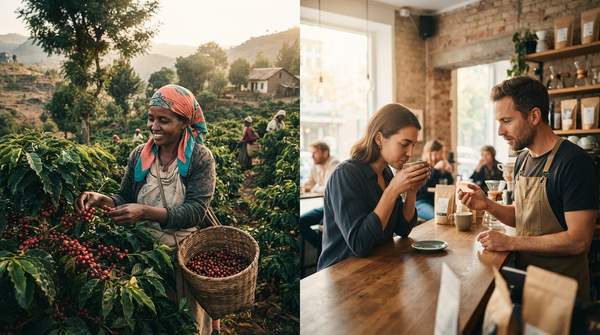
Coffee travel splits into two genuinely different journeys, and picking the wrong one can leave you underwhelmed in a place you spent a fortune to reach. As Colleen Cabili observes in Quartz's survey of the world's best coffee tourism destinations, the field divides between "origin countries where the bean is actually grown and harvested, and coffee culture cities built around café life and roasting rather than cultivation." One puts you on a muddy trail behind a farmer in Guatemala's volcanic highlands; the other puts you in a Melbourne laneway with a flat white. The two experiences, she notes, "offer genuinely different reasons to plan a trip around coffee specifically." Here is how to decide which one deserves your next trip.
Choosing Your Coffee Journey: Origin Farm vs. Urban Culture
Why does the distinction matter so much? Because the two trips reward different travelers, and they rarely satisfy each other's cravings. Origin travel means visiting the places coffee comes from—Ethiopia's highlands, Colombia's Coffee Region, Vietnam's Central Highlands—and your days revolve around cultivation, processing, and the communities that do both. Urban culture travel means visiting cities where coffee is consumed with devotion rather than grown, and your days revolve around cafés, roasters, and the rituals of the cup.
Pure Coffee, writing on the growing coffee tourism trend, frames it as the blend of "two passions: travel and coffee," with travelers seeking both the origins of the beverage and new brewing techniques and experiences. That dual pull is exactly why the choice deserves to be made deliberately. A week of vacation is usually only enough for one archetype done well, and the packing list, budget, and physical demands of each differ sharply.
There is a third, hybrid path worth naming: some destinations offer both. Pure Coffee's survey highlights Saudi Arabia as "quickly becoming the rising star everyone is talking about," a place where the Kingdom's coffee heritage and sustainable farming practices sit alongside an emerging café scene. But hybrids are the exception that proves the rule—you still need to know which half of the trip is pulling you there.
The Allure of Origin Country Coffee Travel
What draws people to origin countries is directness—standing where the bean begins. Pierre Blake's global guide to top coffee destinations describes the appeal as "direct access to coffee's birthplace and heritage farms," along with "deep cultural rituals, like the Ethiopian coffee ceremony," and accommodations ranging from "eco-lodges on plantations to design hotels in coffee capitals." His guide chooses destinations for their "cultural significance, bean quality, and the immersive experiences they offer," which tells you the trip is about far more than tasting.
The activities are tactile in a way no city trip can replicate. Cohica Travel, a travel design agency, describes a Guatemalan experience that includes "a short hike up the side of a volcano to see the coffee fields and learn about the growing process," followed by a visit to the farmer's house to learn the importance of each step and get hands-on with the "pulpero," a machine that removes the external pulp from the coffee seeds, "before roasting the coffee in the traditional Guatemalan way, over the fire in the farmer's kitchen." Read that itinerary again: hiking, farming households, traditional machinery, fire roasting, and coffee tasted minutes from where it grew. That is immersion in the fullest sense.
Vietnam offers a different flavor of the same archetype. Carmen Luo, writing for GEVI, notes that Vietnam has "rapidly ascended to become the world's second-largest coffee producer," known primarily for Robusta beans she characterizes as "bold, earthy, and with a distinctive chocolatey bitterness that shines in local preparations." Destinations like Buon Ma Thuot in the Central Highlands and areas around Da Lat provide opportunities to explore Robusta plantations. Even there, though, she adds that a coffee tour in Vietnam "must include an immersion into its vibrant café culture"—a useful reminder that the archetypes can overlap at the destination level, even when the trip's center of gravity is the farm.
The trade-off is infrastructure. Origin itineraries tend to be multi-day, rural, and physically demanding—trekking is listed as an activity on Happy Gringo's Colombia Coffee Triangle tour, not an optional extra. If your idea of travel misery is a pre-dawn mountain drive to reach a plantation, this archetype will test you.
Exploring Urban Coffee Culture Destinations
The urban archetype trades the farm for the café counter, and Melbourne is the clearest case study. Walking tours through the city's laneways give visitors access to its most iconic roasters and cafés, and current coffee tourism guides highlight the city's flat whites as a benchmark experience, reflecting Melbourne's specific role in shaping and popularizing that espresso-based drink internationally.
What Melbourne represents, in Cabili's framing, is "an entirely different model of coffee travel, urban café culture and craft rather than farm-to-cup origin tourism"—one that gives "travelers without the time or interest in visiting an actual growing region a genuine, deeply developed coffee experience within a single, walkable city." That last phrase carries the whole pitch: you get depth without the logistics of rural travel.
The immersion here is of a different kind. You are not learning how a cherry becomes a green seed; you are learning how a city drinks—its café aesthetics, its brewing techniques, its social rhythms around the cup. Pure Coffee's survey points to the same breadth of urban experiences, from Italian espresso culture to traditional Mayan coffee ceremonies hosted at coffee festivals. The city trip also folds naturally into general tourism: museums, restaurants, and design shopping sit alongside your café crawl, which is precisely why it suits travelers who want coffee as one strand of a richer city break rather than the entire purpose of the journey.
Coffee Travel Archetypes: Choose Your Adventure
Use this table to match the archetype to your own preferences for activities, immersion, infrastructure, and budget. The cost row reflects only what the retained tour listings actually state: Happy Gringo's 8-day Colombia Coffee Triangle itinerary is priced from $1,395 per person, excluding international flights.
| Dimension | Origin Country (Farm-focused) | Urban Culture (Café-focused) |
|---|---|---|
| Travel Archetype | Visiting farms and plantations where coffee is grown — e.g., Ethiopia, Colombia, Vietnam (Buon Ma Thuot, Da Lat), Guatemala. | Exploring café scenes, specialty roasters, and brewing craft in major cities — e.g., Melbourne. |
| Typical Activities | Volcano hikes to coffee fields, hands-on processing with a pulpero, traditional fire roasting in a farmer's kitchen, plantation visits, trekking. | Café-hopping on walking tours through laneways, visiting iconic roasters, benchmark tastings such as Melbourne's flat whites. |
| Level of Immersion | Deep immersion in rural life and the agricultural process — direct access to coffee's birthplace, heritage farms, and farming households. | Immersion in a city's modern lifestyle and consumption rituals — the social and cultural end of the bean-to-cup journey. |
| Travel Infrastructure | More rugged; multi-day itineraries with trekking and rural stays, sometimes paired with city sightseeing (e.g., Medellín's Plaza Botero and Metro Cable on Happy Gringo's itinerary). | Developed, walkable urban tourism infrastructure with cafés, roasters, and broader city attractions integrated together. |
| Cost Range (per week) | Happy Gringo lists an 8-day/7-night Colombia Coffee Triangle tour from $1,395 per person, excluding international flights. | Not established in the sources reviewed — budget separately using city trip costs. |
| Best For... | Travelers who value direct interaction with growers and the production process over urban comforts. | Travelers who prefer varied, comfortable, less physically demanding trips and want coffee folded into city tourism. |
Notice what the table makes explicit: the origin column is dense with verbs—hike, process, roast—while the urban column is dense with nouns of place—laneways, roasters, cafés. That grammatical split is the honest summary of the choice. One trip asks your body to participate in production; the other asks your palate to participate in consumption culture.
Planning the Trip: Season, Boots, and Ethics
Whichever archetype you choose, a few practical considerations shape the experience. Blake's guide emphasizes "easy ways to connect with local producers and world-class roasters," which in practice means researching farms and tours before booking rather than arriving and hoping. His framing—choosing destinations for cultural significance, bean quality, and immersive experience—gives you three filters to apply to any tour operator's marketing copy.
For farm visits, pack for terrain, not for café-hopping. The Guatemalan experience described by Cohica involves hiking up a volcanic slope, so sturdy footwear and weather-appropriate layers matter more than anything you would wear to a Melbourne espresso bar. Timing matters too: hands-on demonstrations like the pulpero session depend on when cherries are actually being milled, so check the harvest calendar of your destination before locking in dates.
Ethically, favor operators who frame the visit as cultural exchange rather than spectacle. Rebecca Adventure Travel, for instance, promotes "Huella Positiva" sustainable travel aimed at preserving "cultures and environments for future generations," alongside what it describes as solid insurance, certifications, and rebooking facilities. Look for that kind of language—plus fair farmer compensation and small group sizes—when choosing a tour, and be skeptical of any farm visit that treats growers as scenery rather than hosts. Happy Gringo's Colombia itinerary illustrates how a responsible trip can be structured: rural coffee plantation visits sit alongside Medellín city sightseeing and a stop in Santa Elena, where travelers meet a traditional flower arranger and learn the history behind that local craft. Coffee origin travel done well is a web of local economies, not a single commodity tour.
Your Next Coffee Journey: A Tailored Decision
So which trip should you book? Choose an origin-country coffee tour if you prioritize deep cultural immersion, hands-on learning about coffee production, and a more rugged travel experience, considering the associated costs and logistical planning. Choose an urban culture trip if you want diverse preparations, café aesthetics, and coffee exploration woven into broader city tourism—Melbourne's walkable laneway scene being the model. Ask yourself one honest question: on your last vacation, do you remember the view or the meal? The view person belongs on a volcano trail in Guatemala; the meal person belongs in a laneway with a flat white.
The measurable signal for which you actually want is simple: the traveler who selects a multi-day farm stay or a comprehensive origin tour package is choosing agricultural immersion; the traveler who books a café walking tour is choosing craft and comfort. Decide which of those two bookings you would make first—then let the destination, the season, and the budget follow from that choice.
Sources
- Best coffee tourism destinations in the world — Quartz
- Coffee Tourism: Exploring Cafes Around the World — Pure Coffee
- Top Coffee Destinations: A Global Journey from Bean to Brew — PIERREBLAKE
- 5 Incredible Coffee Experiences Around The World — Cohica Travel
- Best Coffee Tour Destinations: Kona, Colombia, Ethiopia & Beyond — GEVI
- Colombia Coffee Region Tour — Happygringo
- 4-Day Authentic Colombian Coffee Tour — Rebecca Adventure Travel