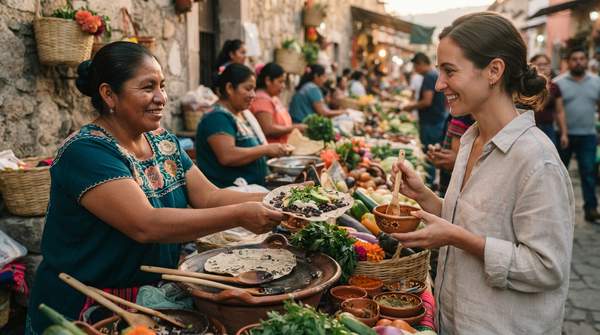
Every meal you eat on the road is a small act of choosing: whose hands touched your ingredients, how much of them ended up in the bin, and whether the people who made the dish were participants in your journey or merely its backdrop. Travelers who want their culinary trips to be more environmentally and socially responsible can focus on three distinct practices—supporting local food systems, minimizing food waste, and engaging authentically with local communities. Each works differently, each carries its own kind of impact, and each can be woven into an itinerary with a little forethought. Here is how they compare, and how to put them to work on your next trip.
Supporting Local Food Systems: A Taste of Authenticity
The first practice is the most intuitive: eat what the place itself produces. Farm-to-table tourism, as the travel writer Rajni Hasija describes it, lets travelers connect directly to a region's heritage and culture through local farming practices and traditional cooking with native products. This is also the heart of Slow Food travel, which the Portuguese tour operator Oh! My Cod frames as a conscientious choice—one that supports local economies, encourages sustainable practices, and fosters cultural resilience, so that communities thrive alongside tourism rather than being overwhelmed by it.
The impact here is largely economic and cultural. Research on culinary tourism in the Baltic Sea Region, published in the journal Sustainability, notes that enterprises adopting local sourcing and regenerative practices strengthen both sustainability and diversification, creating narratives that resonate with ethically minded tourists. On the ground, that means rural economies diversify beyond primary agriculture into multifunctional, food-based experiences. National programs show what this looks like at scale: Visit Iceland's "Iceland's Culinary Treasures," as reported by Jess Henson of the Global Destination Sustainability Movement, incentivizes hotels, restaurants, and caterers to promote local food heritage and use locally sourced ingredients rather than imported ones.
For the traveler, the steps are simple and rewarding: choose farm-to-table restaurants, wander local markets, favor seasonal dishes, and, where you can, buy from organic producers. Hasija's guidance is that consuming seasonal, locally produced meals is itself a form of supporting a green destination.
Minimizing Food Waste: Culinary Conservation
The second practice is quieter but no less consequential. Where local sourcing is about what you eat, waste reduction is about how much of it survives the journey from field to plate. Farm-to-table restaurants, Hasija notes, often run zero-waste kitchens, plastic-free storage, composting systems, and food upcycling methods—practices that minimize the overall environmental footprint of a meal. The Baltic Sea Region research echoes this: circular approaches such as upcycling have become structural in culinary tourism, aligning with EU sustainability priorities.
The primary impact of this practice is environmental. It is also the one where a traveler's own habits matter most, because waste is generated at the table as much as in the kitchen. Carrying reusable utensils, containers, and water bottles; ordering only what you will finish; and choosing establishments that visibly compost or upcycle their ingredients are all concrete moves. GLP Films' Zanny Merullo makes a related point about the educational dimension of sustainable food tourism: travelers often take home eco-friendly practices they discovered on the road, making better-informed consumer decisions long after the trip ends.
Waste reduction rarely announces itself the way a bustling market does. But it is the practice that most directly shrinks the footprint of every meal you eat away from home.
Fostering Authentic Community Engagement: Beyond the Plate
The third practice is the most human. Community engagement means treating food not as a spectacle to consume but as a bridge to the people who make it—interacting with farmers, chefs, and market vendors, and understanding the cultural significance behind what lands on your plate. Hasija's point about interacting with farmers and chefs as a culturally rich activity belongs here: it is how culinary traditions threatened by industrialization stay alive, and how recipes stay within families rather than fading into generic resort menus.
Writing on sustainable food tourism for Yugen Earthside, the author of that guide emphasizes that conscious food choices let travelers see their own impact—especially in rural tourism—while still having "an uncompromisingly wonderful vacation." The same piece offers a useful reframe for moments when no sustainable option presents itself: "Where there are no sustainable options available, a new story can start, recognizing that the sustainability challenge is a constructive collective journey."
Merullo adds a subtler benefit of this human-to-human exchange: it can breed empathy that surpasses cultural and linguistic barriers, making travel more cathartic. In other words, community engagement is not a sacrifice you make for sustainability's sake—it is often the most memorable part of the trip.
Sustainable Culinary Practices at a Glance
The table below compares the three practices side by side, so you can see where each one does its work and what it asks of you. Read it as a menu of sorts: most travelers will find they can combine all three, but if your trip only allows for one focus, this shows what each delivers.
| Practice | Primary Impact | Actionable Tip for Travelers | Benefit for Local Community |
|---|---|---|---|
| Supporting local food systems — prioritizing food and ingredients sourced directly from the destination, as in Slow Food and farm-to-table travel | Economic and cultural: diversifies rural economies beyond primary agriculture into food-based experiences, and preserves culinary heritage | Choose farm-to-table restaurants, visit local markets, eat seasonal and organic local produce | Recipes stay in families and markets remain authentic, keeping food culture economically viable |
| Minimizing food waste — reducing waste across preparation and consumption, including zero-waste kitchens, plastic-free storage, composting, and food upcycling | Environmental: shrinks the overall footprint of meals through eco-friendly preparation and disposal | Carry reusables, order only what you will finish, and favor establishments that compost or upcycle food | Not established by the compared sources for this practice |
| Fostering authentic community engagement — interacting with local people and traditions to understand food's cultural significance, going beyond typical food tours toward cultural immersion | Social: builds empathy across cultural and linguistic barriers and deepens travelers' awareness of their own impact, especially in rural tourism | Talk with farmers, chefs, and market vendors; learn the traditions behind the dishes you eat | Not established by the compared sources for this practice |
Notice the pattern: local sourcing leans economic and cultural, waste reduction leans environmental, and engagement leans social. None of them requires the others to work, but together they cover the full spectrum of what "responsible" can mean at a dinner table far from home.
Your Sustainable Culinary Travel Action Plan
Putting this into practice takes less planning than you might expect. Before you travel, look for destinations and restaurants that advertise local sourcing or zero-waste operations—national programs like Iceland's show that this vocabulary is increasingly visible. While you are there, let the market be your first stop rather than your afterthought: it tells you what is in season, who is selling it, and what the region is actually proud of. Choose at least one meal in a farm-to-table restaurant, carry your own reusables so that takeaway and leftovers do not generate avoidable waste, and order with your appetite rather than your eyes.
Then slow down. Take a cooking class, ask a vendor how a dish is traditionally made, or simply linger long enough for a conversation to happen. These are the moments Merullo identifies as the educational core of sustainable food tourism—the practices you carry home and keep using.
Making Every Meal a Meaningful Journey
Travelers can make their culinary tourism more sustainable by consciously choosing to support local food systems, minimize food waste, and engage authentically with local communities. None of this demands perfection; as the Yugen Earthside guide puts it, sustainability is a constructive collective journey, and a conscious choice is almost always available somewhere in your trip. The measurable sign that you are doing it right is simple: increased participation in local markets, zero-waste dining, and cultural food experiences—your own. Count them on your next itinerary. If you have shopped where the farmers shop, eaten where the kitchen composts, and learned something from the person who cooked your meal, you have traveled well.
Sources
- Sustainable Food Tourism: Best Farm-to-Table Eco-friendly Travel Guide — RRhasija
- Slow Food travel & Immersive culinary Experiences — Oh! My Cod
- MDPI
- Regenerative Food Tourism: How Sustainability and Gastronomy Can Thrive Together [with Examples] — Global Destination Sustainability Movement
- The Benefits of Sustainable Food Tourism — GLP Films
- Yugenearthside