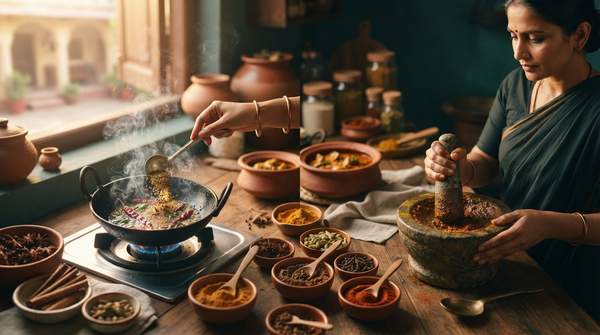
When an Indian curry tastes right, the credit rarely belongs to any single spice. It belongs to when and how the spices met heat and fat. There are two fundamental moves at play: whole seeds sizzled in hot oil or ghee at the very start — the technique called tadka, or tempering — and ground spice blends, the masalas, stirred in during or at the end of cooking. Understand these two pillars and you can read almost any Indian recipe, or improvise your own, with real confidence.
The Two Pillars of Indian Curry Flavor: Masalas and Tempering
Here's the framework I wish someone had handed me years ago. Indian flavor construction runs on two distinct operations. The first is tempering: whole spices or aromatics briefly heated in fat so their essential oils bloom into the dish's foundation. As one guide to the technique puts it, tadka "is not a spice blend, a curry or a particular dish" — it is a method in which spices are heated in oil or ghee specifically to release their aroma and flavour.
The second pillar is the masala: a considered blend of spices, usually ground. Home cooks build entire pantries around these blends — one cook's family garam masala recipe alone called for twenty-one whole roasted spices, later simplified to five ingredients with, in her words, "a similar authentic flavor." The point is that masalas are deliberate constructions, tuned to a dish, not a generic afterthought.
Tadka: The Art of Tempering Whole Spices
Tadka is deceptively simple. You heat oil or ghee, add whole spices or aromatics, and let them sizzle briefly until fragrant. What makes it a genuine technique rather than a flourish is timing and control. Whole spices need enough heat to release their aroma, but left in very hot oil too long they turn bitter. Different ingredients also react at different speeds — whole seeds tolerate heat differently from ground spices, and garlic changes rapidly as it cooks.
There are two ways to deploy it. Sometimes the tadka happens at the beginning of cooking, becoming the flavor base everything else builds on. In other preparations, it is made separately and poured over the food near the end — and that second method is dramatic: a gentle bowl of lentils can, within seconds, take on a completely different aroma as the hot oil and freshly toasted aromatics arrive at the table still highly fragrant. Same technique, two very different jobs.