Here's the good news for anyone dreaming of homemade ricotta or fresh mozzarella: you probably already own most of what you need. Across the beginner guides from cheesemaking suppliers, the same core list keeps appearing—a big non-reactive pot, an accurate thermometer, measuring cups and spoons, a long knife, a colander, a slotted spoon, and cheesecloth. Only a handful of items, like proper cheese molds, are genuinely specialized purchases. The real decision isn't "what do I buy?" It's "what do I already have that's actually suitable?"
Starting Your Cheesemaking Journey: Essential Tools for Beginners
Before you spend a dime, it helps to understand what cheesemaking actually demands of your kitchen. Most beginner recipes start with around two gallons of milk, which means your equipment has to handle volume, gentle heating, and precise temperature control. Cultures For Health puts it plainly: many recipes call for 2 gallons (8 quarts) of milk plus about a cup of additional ingredients, so your pot needs room to stir comfortably, not just room to hold liquid.
That volume requirement is why the humble stock pot tops every supplier's list. Standing Stone Farms recommends 8, 12, or 16-quart pots with lids, and notes that if you're brand new, a cheesemaking kit bundling tools and ingredients together is the most convenient entry point. But a kit isn't required—each piece can be sourced individually, and much of it may already be in your cabinets.
Absolute Necessities: Tools You Likely Already Own
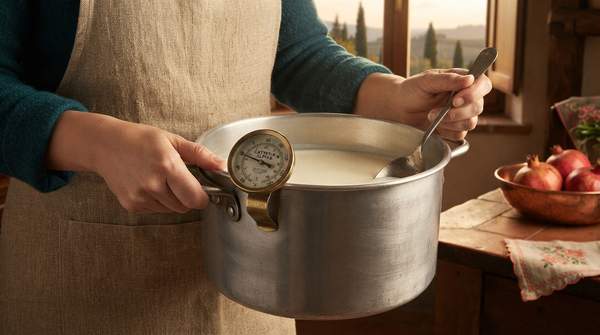
The essential list breaks down into tools with a job in nearly every batch. The thermometer is the one I'd scrutinize hardest: Cultures For Health insists it must be reliable and accurate, and Standing Stone Farms recommends a digital instant-read style reading from 0° to 220°F. Some models include a clip to attach to the pot's side, which they call a handy feature during the process.
Measuring cups and spoons matter more here than in most baking. New England Cheesemaking Supply Company's Sarah Carroll points out that cheesemaking occasionally calls for tiny amounts—1/16, 1/32, or even 1/64 of a teaspoon—so a set including those small measures lets you add ingredients like cultures and rennet more precisely. A standard household pair of stainless steel spoons otherwise works fine.
Rounding out the necessities: a long kitchen knife for cutting curds, a fine-mesh stainless steel strainer or colander, a perforated ladle or skimmer spoon, and cheesecloth or butter muslin for draining. If you cook regularly, you may only be missing the cloth.
Specialized Equipment: Worth the Investment
Then there's the tier of tools that make life easier but aren't strictly required for a first batch. Standing Stone Farms lists drain cloth (flour sack towels or pillowcases with a thread count of 150 or less), parchment paper or a Silpat, and a microwave-safe bowl as "extra helpful items." TheCheeseMaker adds draining mats, which let air circulate around soft or ripened cheeses as they dry and release whey.
Cheese molds are the clearest example of a specialized purchase. They come in various sizes and shapes, typically made from stainless steel or food-grade plastic, and their job is simply shaping your cheese. For a beginner focused on soft cheeses, a colander lined with cheesecloth can do similar work while you decide whether the hobby sticks.
One more note from TheCheeseMaker: a large bowl is genuinely useful for catching whey and heating milk, with 13 quarts cited as a good size. It's the kind of thing many kitchens already have.
Why Materials Matter: Avoiding Reactive Surfaces
Here's where beginners can quietly ruin a batch before it starts. Cultures For Health is explicit: the pot should be stainless steel or unchipped enamel, and you should avoid aluminum and other reactive metals. TheCheeseMaker echoes this for colanders and strainers—use non-reactive material such as plastic or enamel "to prevent harmful substances from getting into your cheese and for safety purposes."
The logic is straightforward. Cheesemaking involves acidic mixtures sitting in contact with your cookware for extended periods, and reactive metals can interact with those acids. Stainless steel sidesteps the problem entirely, which is why suppliers keep recommending it across pots, skimmers, and measuring spoons alike. That chipped enamel pot in your cupboard? The damage isn't cosmetic—chips expose the reactive metal underneath.
The same thinking extends to utensils. For stirring, TheCheeseMaker suggests bamboo, nylon, stainless steel, or plastic—materials that won't react with your curds. When every supplier independently lands on the same material guidance, it's worth treating as a rule rather than a suggestion.
Essential Cheesemaking Tools: A Comparative Guide
I've consolidated the supplier lists into a single reference, sorted by necessity. The "Absolute Necessity" tier is what you need before your first batch; the "Helpful Extra" tier improves the process but can wait. Check your kitchen against the first seven rows and you'll know exactly what remains on your shopping list.
| Tool | Primary Function | Key Feature (Material/Size) | Necessity Level |
|---|---|---|---|
| Large pot | Heating milk and cooking curds | 8, 12, or 16 quarts; stainless steel or unchipped enamel—avoid aluminum | Absolute necessity |
| Thermometer | Ensuring milk reaches correct temperatures | Reliable and accurate; digital instant-read, range 0° to 220°F; pot clip is a handy feature | Absolute necessity |
| Measuring cups and spoons | Accurate measurement of cultures and rennet | Stainless steel; sets including 1/16, 1/32, or 1/64 tsp measures allow precision | Absolute necessity |
| Long knife | Cutting curds evenly | Long blade for uniform cuts through the curd mass | Absolute necessity |
| Colander/strainer | Draining whey from curds | Non-reactive material—stainless steel, plastic, or enamel; fine mesh preferred | Absolute necessity |
| Slotted spoon/skimmer | Stirring curds and lifting them from the pot | Stainless steel skimmer or perforated ladle | Absolute necessity |
| Cheesecloth/butter muslin | Draining curds and forming cheese | Reusable options available; flour sack towels or pillowcases (thread count 150 or less) work | Absolute necessity |
| Cheese molds | Shaping finished cheese | Various sizes; stainless steel or food-grade plastic | Helpful extra |
| Draining mats | Air-drying soft or ripened cheeses | Allows air circulation as whey drains | Helpful extra |
| Large bowl | Catching whey and heating milk | Around 13 quarts is a good size | Helpful extra |
Notice how much of the necessity tier is defined by material rather than by exotic design. The pot, colander, and spoon are ordinary kitchen items—the only question is whether yours are non-reactive and large enough. The genuinely purpose-built pieces, the thermometer with the right range and the fine cheesecloth, are inexpensive and do the most precise work in the process.
Making Your First Cheese: What to Acquire First
Beginners should prioritize acquiring a non-reactive large pot, an accurate thermometer, measuring tools, a long knife, a colander, a slotted spoon, and cheesecloth—these are the absolute necessities, and several are probably already in your kitchen. Specialized items like cheese molds and draining mats can be added as the hobby progresses. This guide covers the beginner tier for soft cheeses like ricotta and mozzarella; hard, aged cheeses need equipment such as presses and aging setups that's a separate conversation, and prices vary too widely by retailer and quality to quote meaningfully here.
Your measurable checkpoint: before attempting your first soft cheese recipe, confirm you've gathered the full core set—pot, thermometer, measuring tools, knife, colander, spoon, and cloth—and that each one passes the non-reactive test. If your pot is aluminum or your enamel is chipped, that's the first replacement to make. Once those seven items are lined up on your counter, you're equipped to start.