A tagine works because of a simple, elegant physical loop: the tight-fitting conical lid traps rising steam, condenses it on its cool sloped surface, and drips it back over the food, so the dish braises in its own juices with very little added liquid. That cycle, not any secret ingredient, is what produces the tender, concentrated stews Morocco is famous for. And here's the practical upshot for your kitchen: you don't strictly need one. A Dutch oven with a tight-fitting lid accomplishes nearly the same slow-braising result, as Melissa Clark notes in her guide for NYT Cooking — though traditional unglazed clay brings a flavor character that metal can't.
The Tagine Pot: A Masterpiece of Moisture and Flavor
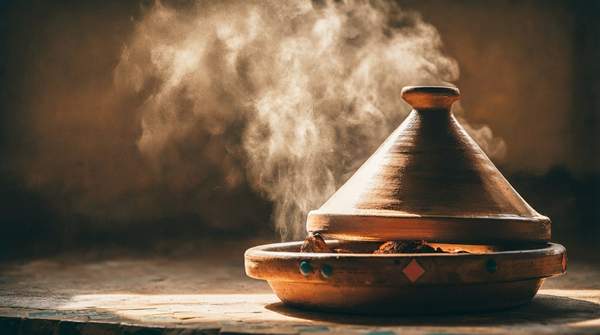
I love the tagine because it's one of those rare objects where the beauty and the engineering are the same thing. The pot — also called a tagine, like the dish itself — is traditionally made from heavy clay, chosen to hold in heat and withstand daily use. Historically, it served nomads as a portable cooker heated over charcoal braziers: a shallow base for both cooking and serving, topped by that unmistakable conical dome. The form is lovely, yes, but as the culinary writers at D'Artagnan put it, it is "the epitome of functionality." The whole apparatus exists to make a little water go a long way — a design that matters especially where water is scarce — while coaxing the deepest flavor out of humble ingredients.
The Science of Slow: How the Tagine's Cone Works
So what is the cone actually doing up there? Think of the tagine as a tiny, self-regulating steam engine. The base simmers the food; vapor rises off the stew and climbs into the wide, tall lid. That lid, relatively cooler than the bubbling base and with far more surface area than a flat cover, cools the steam, and the moisture condenses on the cone's interior. Then gravity does the rest: droplets run down the slope and drip back onto the ingredients, continuously basting them.
This loop is the entire point of the shape. A flat-lidded pot lets vapor escape or pool; a tagine recycles it. That's why a tagine needs very little additional liquid compared with, say, a wine-braised ragout — the stew essentially steams itself in its own aromatic vapor. In an unglazed ceramic pot, some liquid is also gradually absorbed by the clay interior, further concentrating what remains. Once most of the liquid has evaporated or been reabsorbed by the food, the hot ceramic effectively becomes an oven that bakes the dish. Less water, more flavor — that's the trade the cone makes on your behalf.
Tagine Pot Function: The Self-Basting Cycle
To use a tagine well, it helps to see the cycle as a sequence you can actually manage at the stove. Here is the complete loop, stage by stage:
- Heat source: Low, gentle heat — traditionally a charcoal brazier, at home often a diffuser-protected hob — warms the base.
- Base (braising): The shallow base holds meat, vegetables and spices in a small amount of liquid, which begins to simmer and release flavorful vapor.
- Steam rise: Aromatic steam climbs off the simmering food into the tall cone, carrying moisture and volatile flavor compounds upward.
- Cone (cooling and condensation): The larger, cooler surface of the cone-shaped lid cools that vapor, turning it back to liquid; in unglazed pots some moisture also absorbs into the clay.
- Liquid return: Condensed droplets run down the cone and drip back over the ingredients, basting them in their own juices and restarting the cycle.
The practical lesson: because the loop recycles moisture, you add far less liquid than you think you need, and you keep the heat low enough that the cycle works steadily rather than boiling everything off. Once the liquid has been absorbed or evaporated, the hot ceramic finishes the dish like an oven. This staged sequence is exactly what distinguishes a tagine from a standard pot with a loose lid — and it's the checklist your cooking should follow.
Choosing Your Tagine: Traditional Earthenware vs. Modern Materials
Now the purchasing decision, which mostly comes down to clay versus convenience. Traditional tagines were earthenware and unglazed; a genuine Beldi folk tagine is beautifully simple, often unglazed, and the clay itself imparts a desirable, unique flavor during cooking. Today tagines also come glazed, decorated, or in heavy enameled cast iron — the typical modern European construction pairs a cast-iron base with an earthenware top, and one French maker produces a glazed all-ceramic version from Burgundy clay.
Before you buy, sort serving from cooking: the highly decorated tagines are usually for serving only and cannot take heat. If you go traditional, earthenware pots should be seasoned before use — following the manufacturer's directions — to prevent cracking and to remove any unpleasant raw-clay taste in unglazed versions. On electric or gas hobs, use a heat diffuser and start at very low heat. If that sounds like more ceremony than you want, there's a contemporary middle path: flameware, a flameproof ceramic that needs no seasoning and isn't sensitive to heat.
Tagine vs. Dutch Oven: A Comparative Look
Here's the honest question: do you need a tagine at all? Functionally, maybe not. Clark is clear that a Dutch oven with a tight-fitting lid "will accomplish nearly the same thing" — it also traps vapor and returns it, producing comparable slow-braised tenderness with modest liquid. The difference lies in the margins of flavor and character.
An unglazed earthenware tagine has, in the words of Nargisse Benkabbou of My Moroccan Food, "an incredible capacity to simmer the food, allowing all the natural and genuine flavours of the ingredients to be tastefully released" — and the clay contributes its own earthy note that glazed and cast-iron vessels simply don't. Cast iron and Dutch ovens, in exchange, demand no seasoning and no diffuser anxiety. So the choice is a trade: authentic flavor and ritual on one side, durability and ease on the other. Neither is wrong; they optimize for different cooks.
Practical Tips for Using Your Tagine
Whichever vessel you choose, a few habits protect it and your dinner. First, verify your tagine is a cooking pot, not a serving piece — the decorated ones cannot be exposed to heat. Second, season an earthenware pot before its first use, glazed or unglazed, per the manufacturer's instructions. Third, on electric or gas hobs, always set a heat diffuser between burner and base. Fourth, begin cooking at very low heat and let it climb gradually; clay likes patience, and the low start keeps the condensation cycle steady. And cook with restraint on liquid — trust the cone to return what rises.
Making Your Tagine Choice and Mastering Its Use
Choose a tagine pot based on desired flavor profile — traditional unglazed earthenware for that characterful, clay-kissed depth — and on practical considerations: glazed or cast-iron versions for durability and ease of use, or a Dutch oven for nearly equivalent slow-braising results. You'll know your choice was right, and your technique sound, by a measurable outcome: the resulting dish is tender, moist, and rich in concentrated flavors, with minimal liquid added during cooking. If your stew emerges bathed in its own juices rather than swimming in added stock, the cone has done its job — whether it came from a Marrakesh souk or your kitchen cabinet's trusty Dutch oven.