If you're wandering a Southeast Asian night market with a sweet tooth and limited stomach space, the real question isn't whether to eat dessert—it's which one. The honest answer: it comes down to texture. Do you want something hot and crispy from the fryer, a soft griddled pancake, or a cool, creamy fruit-and-rice combination? Here are three distinct street desserts—Indonesia's pisang goreng, Thailand's khanom khrok, and Thailand's mango sticky rice—that cover that entire spectrum, and each one is a fixture of street stalls and market culture rather than a restaurant-only indulgence.
Pisang Goreng: The Crispy Fried Banana Treat
Pisang goreng is a staple Indonesian snack, and it earned international recognition when it ranked No. 14 among Southeast Asian treats on a world's-best desserts roundup reported by VnExpress International. That's a high placement for something so humble: sliced bananas or plantains, dipped in batter, then deep-fried to a golden crisp.
What makes it a street food experience is the setting. Traditionally, pisang goreng is sold by street stalls and mobile carts, meaning you'll often smell it before you see it—hot oil and caramelizing fruit are hard to hide. The moment of eating matters too: the exterior shatters while the banana inside stays soft and steaming.
Modern vendors have expanded the treat well beyond its simple origins. According to the same VnExpress International report, contemporary variations often feature toppings like powdered sugar, cinnamon, chocolate drizzle, jam, and even ice cream. So if you spot a cart offering pisang goreng with a scoop of vanilla melting over the hot fritter, you're looking at the dessert's current evolution, not a tourist invention. If crispy, hot, and fruit-forward sounds like your ideal bite, this is your safest first order at any Indonesian market.
Khanom Khrok: Savory-Sweet Coconut Pancakes
Khanom khrok is a popular Thai street food, described as a small-sized pancake or pudding, prepared with a batter combining rice flour and coconut milk. That two-ingredient foundation is what defines it: the rice flour gives body and a gentle chew, while the coconut milk contributes richness and a distinctive aroma you can pick out from across a market row.
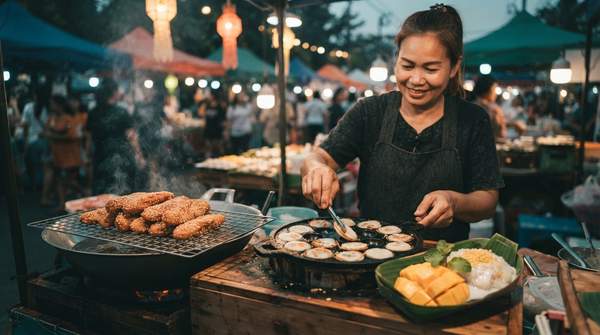
The preparation is part of the charm. Vendors cook the batter in a special griddle—typically a cast-iron or heated pan with rows of small hemispherical indentations—which is what gives khanom khrok its characteristic shape: little round, slightly domed cakes, crisp at the edges and softer, almost pudding-like, in the center. Watching a vendor work the griddle, pouring batter into each dimple in rapid succession, is half the reason to order them.
Because the batter is built on rice flour and coconut milk rather than wheat flour, the texture lands somewhere between a pancake and a steamed pudding—soft, tender, and coconut-forward. If you prefer your sweets on the gentler, more aromatic side rather than fried and flashy, khanom khrok is the middle path between the other two desserts here.
Mango Sticky Rice: A Creamy Thai Classic
Mango sticky rice—khao neow mamuang in Thai, where khao neow means glutinous sticky rice and mamuang means mango—is the famous Thai street food that food writer Mark Wiens describes as an authentic street-style dessert built on three elements: mango, sticky rice, and coconut cream. Marion Grasby, who publishes recipes through Marion's Kitchen, calls it "a beautifully creamy tropical dessert that is a wonderful finish to a meal."
The components are simple but deliberate. Glutinous rice is soaked, then steamed—Grasby's method calls for overnight soaking and steaming in a bamboo steamer—and enriched with sweetened, salted coconut milk. The rice is served beside sweet, fresh-cut ripe mango, with a salted coconut sauce spooned over the top. Pailin Chongchitnant of Hot Thai Kitchen adds a finishing touch that many travelers notice but can't name: a sprinkle of crispy mung beans, which add a contrasting crunch to the creamy rice.
The flavor profile is what sets it apart from the fried and griddled options. It's typically served at room temperature or cool, with the sweetness of ripe mango balanced by salted coconut sauce—rich, creamy, and refreshing rather than hot and crisp. If your ideal dessert is fruit-forward but luxurious, this is the one to seek out.
Comparing Southeast Asian Street Food Desserts
Here's the side-by-side view. The point of the table is to let you match a dessert to your texture preference before you're standing in front of a stall, hungry and overwhelmed by choice.
| Dessert | Country of Origin | Key Ingredients | Preparation Method | Flavor & Texture |
|---|---|---|---|---|
| Pisang Goreng | Indonesia | Sliced bananas or plantains, batter; modern toppings like powdered sugar, cinnamon, chocolate drizzle, jam, ice cream | Deep-fried to a golden crisp, sold by street stalls and mobile carts | Hot, crispy exterior with soft fried fruit inside |
| Khanom Khrok | Thailand | Rice flour, coconut milk | Cooked as small pancakes or puddings on a street-food griddle | Soft, tender, coconut-rich; crisp edges with a pudding-like center |
| Mango Sticky Rice | Thailand | Glutinous sticky rice, coconut milk, ripe mango, salted coconut sauce; crispy mung beans as a topping | Rice soaked and steamed, then served beside fresh-cut mango with coconut sauce spooned over | Creamy, rich, and refreshing; sweet mango balanced by salted coconut |
Read the table as a decision tool, not just a list. The three desserts occupy three different corners of the sensory map: pisang goreng is the hot, crispy, fried option; khanom khrok is the soft, griddled, coconut-aromatic middle ground; and mango sticky rice is the cool, creamy, fruit-and-rice indulgence. The ingredient axis matters too—banana versus rice flour versus mango means you're also choosing your dominant flavor, not just your texture.
Deciding Your Next Sweet Adventure
Choose your next Southeast Asian street food dessert based on whether you prefer a crispy fried fruit, a soft savory-sweet pancake, or a rich, creamy fruit-and-rice combination. That single preference will point you to the right stall faster than any list of "must-eats."
My suggestion for the adventurous eater: don't pick just one. These three desserts rarely compete at the same market—pisang goreng dominates Indonesian stalls and carts, while khanom khrok and mango sticky rice are Thai street staples—so a multi-country trip lets you try each in its home setting. The measurable indicator of success is simple: the availability of these distinct dessert types at night markets and street food stalls. If you find all three during your travels, you've eaten your way through the full texture spectrum Southeast Asian street sweets have to offer—crispy, soft, and creamy, one market at a time.
Sources
- 5 Southeast Asian desserts named among world's 100 best — VnExpress International – Latest news, business, travel and analysis from Vietnam
- Thai Mango Sticky Rice Recipe: Authentic Thai Street Food Style! — Thai Street Food, Restaurants, and Recipes | Eating Thai Food
- Thai Mango Sticky Rice — Marion's Kitchen
- Mango Sticky Rice Recipe - Hot Thai Kitchen