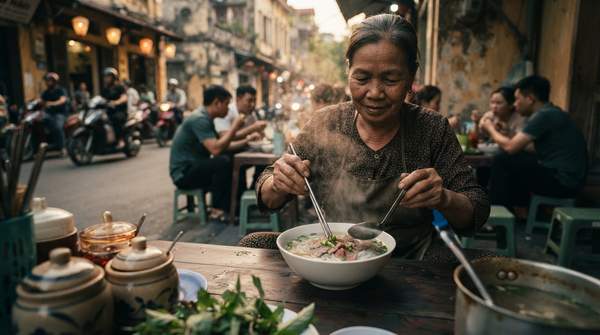
Pho was born in Northern Vietnam in the early twentieth century, and its two great styles split apart for a concrete historical reason: the 1954 division of the country pushed northern cooks and their pho culture southward, where the dish absorbed new ingredients and a new character. Northern pho (Phở Bắc) is a clear, restrained, beef-focused bowl; Southern pho (Phở Nam) is richer, sweeter, and comes trailed by platters of herbs and sauces. Once you know what to look for, you can usually place a bowl within seconds of it hitting the table.
Phở Bắc: The Northern Original
Pho emerged in Northern Vietnam in the early twentieth century, and both French and Chinese culinary traditions are believed to have shaped it—and even the name itself, which many accounts trace to the French pot-au-feu, the beef soup that colonial officials preferred. The beef connection is the clearest imprint of colonialism. As one retelling of the dish's origin puts it, northern Vietnamese took the beef parts and bones their French conquerors did not want and built a dish from them, which is widely believed to be how the northern style, Phở Bac, came to be.
The Chinese contribution was the noodle: rice noodles and broth traditions from China gave the dish its form and its Chinese-influenced etymology, a debate that remains genuinely unsettled because documentation from the dish's early decades is thin. What is not disputed is the birthplace. Nam Định, south of Hanoi, is considered by many to be pho's cradle, and the dish belongs to the north before anywhere else.
Northern pho has stayed close to that austere beginning. The broth is its entire argument—clear, light, and delicate, built on the pure essence of beef with only a whisper of sweetness and minimal spicing. Noodles tend to run wider than their southern cousins. Garnishes are deliberately few: rare beef and scallions, and not much else. Sprouts do not belong in the northern bowl. The point is the broth; everything else is meant to stay out of its way.
Phở Nam: The Southern Adaptation
Then history intervened in the dish. In 1954 the country was divided into North and South Vietnam, and many northerners migrated south, carrying pho culture with them. As the dish traveled, southern cooks kept infusing it with additional ingredients until it evolved into the style known today as Phở Nam—a bowl shaped by migration rather than invention from scratch.
The changes touch every layer. The broth grows richer and sweeter, with more spices and often added sugar. Noodles are thinner, which changes the texture of every spoonful. And presentation is where the south truly departs: instead of the north's spare approach, the southern bowl arrives alongside a wide array of garnishes—fresh herbs like basil, cilantro, and mint, bean sprouts, lime wedges, and other vegetables—so each diner rebuilds the bowl to taste.
That customization extends to the table condiments. Accounts of the southern style describe hoisin and sriracha offered on the side as a standard part of the experience, letting diners adjust flavor bowl by bowl. Where the northern bowl asks the cook to finish the work, the southern bowl makes the diner a co-author. (One point of craft survives both styles: pho's quality rests first and foremost on the broth, whatever is later piled on top.)