What happens when a cup of coffee takes an hour, involves roasting beans in front of you, and ends only after three separate servings? You get the Ethiopian coffee ceremony, or buna tetu — "drinking coffee" — a ritual that transforms raw green beans into a shared social event. The ceremony unfolds in three phases: preparation, brewing, and serving, with the serving itself divided into three rounds called abol, tona, and baraka, each brewed from the same grounds and growing progressively lighter. Understanding the sequence, the tools, and the hostess's central role is the key to appreciating what Ethiopians mean when they say, as the proverb goes, "Coffee is our bread."
The Heart of Ethiopian Culture: An Introduction to Buna Tetu
In most parts of Ethiopia, this is not an occasional spectacle but a daily rhythm — the ceremony takes place three times a day, in the morning, at noon, and in the evening, as described by Bunna Cafe, an Ethiopian cultural venue. Each household may participate as often as three times daily, and being invited is itself a sign of respect and friendship. Writing for Sagebrush Coffee, Karla Walker notes that in some regions it is considered the single most important social occasion.
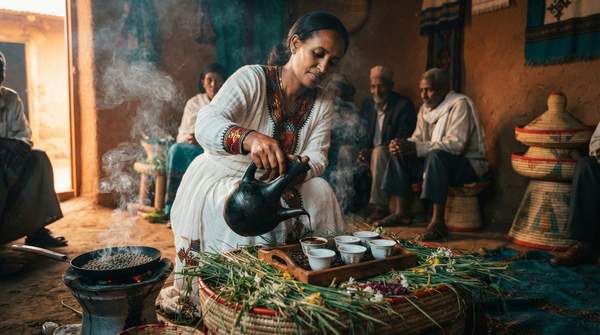
What makes the ceremony distinctive is that nothing is hidden. Guests watch the entire process — washing, roasting, grinding, brewing — over roughly half an hour before a single cup is poured. The ritual is a deliberate assertion that coffee is not a commodity to be consumed quickly but an occasion to be inhabited. As Mauch Chunk Coffee's cultural guide puts it, the ceremony is "a unique and immersive experience" that showcases the nation's deep appreciation for coffee and the importance of fostering social connections through shared experiences.
The Hostess: Guardian of Tradition and Hospitality
Every ceremony has a center of gravity, and it is almost always a woman. The hostess — typically the matriarch of the household — prepares the coffee, and this is described as a high honor. Her authority is not merely logistical. "Her role is one of cultural authority," explains Ethio Coffee's guide to the ceremony. "She sets the pace, controls the quality, and ensures every guest feels welcome."
Her leadership begins before the beans even touch the flame. In preparation, leaves and flowers are placed where the coffee will be brewed, and the green beans are washed by hand. She then roasts the beans in front of her guests using a pan over an open flame — a performance of skill and hospitality at once. Ethio Coffee also notes that in recent years some urban areas have seen men and younger generations participating more actively, a shift that reflects evolving social norms while preserving the ritual's core values of hospitality and community.