Why does an Époisses smell like a monastery cellar at high tide while a Camembert tastes of cream and mushrooms, and a Roquefort bites with spice? The answer is not geography, terroir, or even the milk alone. According to a survey of 137 different cheeses conducted by researchers writing for MicrobialFoods.org, the single best explanation for what lives on a cheese rind is the environment the cheesemaker deliberately creates on its surface: wash it, and certain microbes arrive; inoculate it with mold, and a different community takes hold. In other words, if you build it, they will come.
What follows is a practical model of that process. Each major aging strategy — washed-rind, bloomy-rind, and blue-veined — is a deliberate act of microbial cultivation, and each cultivates a distinct ecosystem whose chemistry you can taste.
The Science of Flavor: Proteolysis and Lipolysis
Fresh cheese is fairly bland rubber. What turns it into something worth savoring is decomposition, carefully managed. Two biochemical pathways do most of the work, and a review of cheese flavor biochemistry published in Frontiers in Microbiology in 2021 by Xiaochun Zheng, Xuewei Shi, and Bin Wang describes both.
The first is proteolysis: the breakdown of proteins. The second is lipolysis: the breakdown of fats. Both are driven by enzymes from microbial cultures — bacterial, yeast, and fungal starters — and both release smaller compounds that carry aroma and taste. The review is explicit that distinct cheese flavors arise from differences in fermentation conditions and starter cultures, and that fungal starters such as Penicillium species carry both proteolytic and lipolytic activity. So the microbes are not passengers; they are the workforce, dismantling the cheese's own protein and fat into the flavor-active fragments we perceive.
This is the key to the whole article. When you read that a mold "accelerates ripening" or a bacterium gives a cheese its "strong character," the underlying event is always one of these two pathways: protein or fat, taken apart, molecule by molecule. The differences among cheese families are differences in which microbes get to do the taking apart.
Crafting the Rind: Washed-Rind Cheeses
Washed-rind cheeses begin with a simple intervention: the cheesemaker repeatedly washes the surface of the aging cheese, typically with a brine or other solution. The point of the washing is not cleanliness. It is to create a moist, salty surface environment that favors particular microbes — and, just as importantly, discourages the molds that would otherwise colonize a dry rind.
That environment reliably summons its residents. Among them are Geotrichum and the so-called "red bacteria," and the affineur Germain, describing its own Époisses, credits precisely this pairing: Geotrichum gives the cheese its signature creaminess and delicate floral notes, while the red bacteria are responsible for its beautiful orange hue and strong character. Notice what this means in chemical terms. The creaminess is proteolysis — the paste softening as proteins are broken down from the rind inward. The floral notes and the assertive aroma are the volatile outputs of the same microbial metabolism.
So the washed rind of an Époisses or a Munster — orange, pungent, often runny at room temperature — is not an accident of place. It is the predictable outcome of a washing regime that built a habitat, and the microbes that habitat selects for.
The Velvety Bloom: Bloomy-Rind Cheeses
Bloomy-rind cheeses take the opposite approach. Instead of washing microbes onto the surface, the cheesemaker inoculates the cheese with molds — the MicrobialFoods.org researchers describe this as one of the defining techniques cheesemakers use to create specific rind types. The classic result is the white, downy coat of a Camembert or Brie.
The Frontiers review identifies the mechanism: a fungal starter containing Penicillium albicans produces white hyphae — the fine filaments that form that velvet-like bloom. The same fungus brings proteolytic and lipolytic activity to the party. As it works from the outside in, it softens the paste just beneath the rind, which is why a well-ripened bloomy cheese flows toward its edges when cut, and why its flavors are comparatively gentle and mushroomy-creamy rather than aggressively pungent.
The contrast with washed rinds is instructive. Both strategies enlist surface microbes that digest the cheese from outside in; both produce softening through proteolysis. But washing cultivates moisture-loving bacteria and yeasts on the rind, while blooming cultivates a white mold. Different habitat, different workforce, different cheese.
The Veins of Flavor: Blue-Veined Cheeses
Blue cheeses move the microbes inside. Here the cheesemaker inoculates the curd or milk with Penicillium roqueforti, the mold responsible for the veins. The Frontiers review reports that P. roqueforti accelerates ripening and produces a spicy flavor and a dark green color — the characteristic veins of a Roquefort or Bleu d'Auvergne, both named by Germain among the strong-flavored cheeses built by microbial action. Yeasts can assist: the review notes that Candida lipidotica has been used in blue cheese production.
What makes blues especially interesting is that the specific strain matters. A study indexed on PubMed, in which researchers made blue cheeses to Roquefort-type production specifications and inoculated each cheese with a single P. roqueforti strain drawn from four different populations, found a strong effect of those populations on the volatile and metabolic compounds responsible for aromas, flavor, and texture — using proteolysis and lipolysis markers to track the differences. Same species, same technique, different results. The vein mold is not a monolith; its population identity shapes what the cheese becomes.
Cheese Aging Strategies: Microbes, Methods, and Sensory Outcomes
The model below gathers the three strategies side by side. Read each row as a causal chain: the cheesemaker's intervention creates a habitat, the habitat cultivates specific microbes, the microbes execute proteolysis and lipolysis, and the sensory result follows. You can use it in reverse, too — identify a cheese's aging strategy, and you can anticipate what it will taste and feel like.
| Aging Strategy | Cheesemaker's Action | Key Microbes Cultivated | Biochemical Action | Resulting Flavor/Texture Profile |
|---|---|---|---|---|
| Washed-rind | Repeated washing of the rind surface to create a distinctive environment | Geotrichum and "red bacteria" (e.g., Brevibacterium-type surface flora) | Proteolysis softening the paste; microbial output giving aroma and color | Creaminess and delicate floral notes from Geotrichum; orange hue and strong character from red bacteria — as in Époisses and Munster |
| Bloomy-rind | Inoculating the cheese with molds | Fungal starter Penicillium albicans, producing white hyphae | Proteolytic and lipolytic activity working from the rind inward | White velvet rind; gentle, creamy flavors and a softening paste |
| Blue-veined | Inoculating with fungal starter Penicillium roqueforti | P. roqueforti (population matters); yeast assistants such as Candida lipidotica | Accelerated ripening via proteolysis and lipolysis; strong effect of strain on volatile compounds | Spicy flavor and dark green veins — as in Roquefort and Bleu d'Auvergne |
The Cheesemaker's Control and the 'House Microbiome'
So how much of this is deliberate, and how much is simply the cheese picking up whatever floats through the cellar? The honest answer is: both, and the division is measurable.
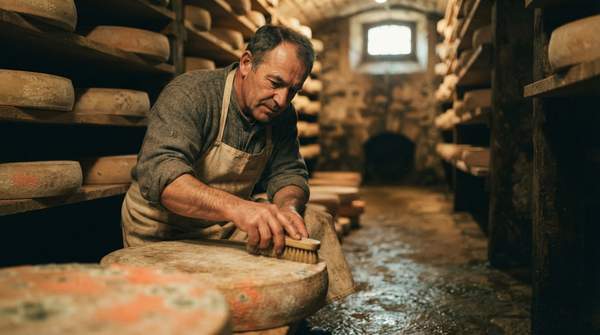
On the deliberate side sits everything the affineur does. Germain describes its aging cellar (the hâloir) as a specially designed space where cheese develops its final aromas and texture under the master ager's watch, with choices beginning at curd selection and salting — some cheeses dry-salted, others brined — and continuing with manual brushing to aid rind development. Temperature, humidity, washing, salting: these are the levers.
But the facility itself contributes. A study of artisanal cheesemaking plants published in PMC found that when aging-room bacterial communities were analyzed, they clustered by facility — each plant harbored phylogenetically distinct subpopulations forming unique communities. Yet on the cheese surfaces themselves, clusters formed by process type, across facilities and independently of inoculation. The process decides who lives on the rind; the building decides which exact strains of them. That is the "house microbiome": an ambient signature that persists in the aging rooms and colors the details even as the cheesemaker's technique sets the broad architecture.
This is why the MicrobialFoods.org researchers found no correlation between geography and rind communities across their 137 cheeses — and why two cheesemakers in the same valley can make profoundly different cheeses. It is also why the same cheesemaker, moving to a new building, may notice the details shift while the technique holds.
Some boundaries worth keeping: this model covers three major strategies, not every cheese; the flavor compounds discussed are illustrative, not a complete chemical analysis; and this is appreciation, not a home-cheesemaking manual.
Appreciating Cheese: A Microbial Journey
To better appreciate and select artisanal cheeses, focus on understanding the specific aging strategy and the microbial activities it cultivates, as these are the primary drivers of distinct flavor and texture. The test is simple: the next time you stand at a cheese counter, identify the aging category — washed, bloomy, or blue-veined — and predict the profile before you taste: expect pungency and creaminess from a washed rind, gentle mushroomy softness from a bloom, and spice from the veins. When the cheese matches your prediction, you will have demonstrated exactly what the evidence shows: that the cheesemaker's chosen environment, and the microbes it summons, are what your palate has been reading all along.
Sources
- Surveying cheese rind microbial diversity - MicrobialFoods.org
- Frontiers | A Review on the General Cheese Processing Technology, Flavor Biochemical…
- Cheese Aging : The Keys to a Unique Taste — Germain
- Strong effect of Penicillium roqueforti populations on volatile and metabolic compounds responsible… — PubMed
- Facility-Specific “House” Microbiome Drives Microbial Landscapes of Artisan Cheesemaking Plants - PMC