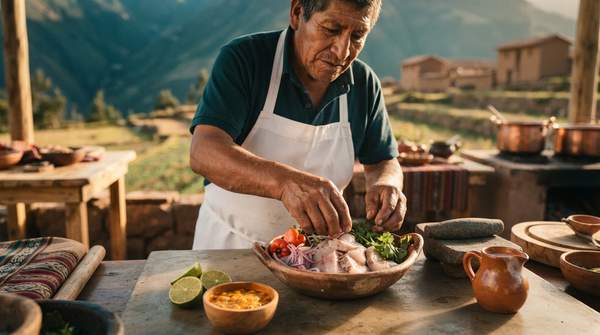
Peruvian ceviche is not one dish but a conversation between history and geography, and you can read both in a single spoonful. The historical accounts behind most cultural retellings trace it to pre-Columbian coastal peoples who cured raw fish in tart tumbo fruit juice and later in fermented corn chicha. Spanish colonists redirected the dish in the sixteenth century by bringing lime and onion, the pair that still defines the modern cure. Then Peru's landscapes took over: on the north coast, Tumbes swaps in black clams; in the Andean city of Arequipa, river shrimp arrives dressed in fiery rocoto.
Regional Diversity: Ceviche Across Peru's Landscapes
Fix the shared template first, because every regional style defines itself against it. The classic cebiche, as the official Peruvian gastronomy site Perú Info describes it, is made with fresh fish, lemon juice, chili pepper, red onion, and salt. Wikipedia's account of the dish adds the texture of tradition: corvina, or sea bass, was the fish traditionally used, and the mixture was traditionally marinated for several hours and served at room temperature, with chunks of corn-on-the-cob and slices of cooked sweet potato alongside.
So how did that template take shape? The story is usually told in three waves, and each one is still detectable in today's versions:
- Pre-Columbian cures. Before Europeans arrived, historical accounts hold, coastal peoples preserved raw fish in the juice of the tumbo fruit and, later, in chicha, the fermented corn drink of the Andes.
- The Spanish turning point. Lime and onion arrived with sixteenth-century colonization, those accounts continue, and citrus displaced the older curing liquids, sharpening ceviche toward the bright, acidic profile recognized today.
- The Nikkei shortcut. Japanese immigrants and their descendants, twentieth-century accounts add, popularized curing the fish for minutes rather than hours—preservation become immediacy.
That layered pedigree is now a matter of national record: Peru's National Institute of Culture (INC) has formally recognized cebiche for its historical and cultural significance in Peruvian gastronomy. Yet the same national pride that canonizes the classic also multiplies it. As Perú Info notes, several regional variations exist across Peru, each shaped by whatever protein its landscape supplies best—which brings us to the regions themselves.
Coastal, Andean, and Amazonian Delights
Along the Pacific, the ocean writes the menu, and even the coast disagrees with itself about fish. Encyclopedic accounts note that lenguado—sole—is often used in Lima, while a specialty of Trujillo, farther north, is ceviche prepared from shark, known locally as tollo or tojo. The boldest coastal substitution waits in Tumbes, near the Ecuadorian border: cebiche de conchas negras, which Perú Info describes as using black clams instead of fish and gaining "a more intense and distinctive flavor."
Climb into the Andes and the protein changes with the altitude. Arequipa's cebiche de camarones is prepared with river shrimp and served with ground rocoto, Perú Info explains, the Andean chili that lends the dish its spicy kick. Rocoto's mountain credentials appear in the encyclopedic record as well, which lists it among the regional and contemporary additions to the classic formula—highland produce traveling downhill into the national bowl.
The same substituting logic runs through all three of Peru's great landscapes, coast and sierra and jungle alike, and the Amazon's rivers hint at freshwater variations of their own. Regional and contemporary versions on record add garlic, fish bone broth, minced Peruvian ají limo, toasted corn or cancha, and yuyo, a seaweed, to the base. Geography, in other words, is the co-author of the recipe.
Comparing Peru's Diverse Ceviche Styles
Here is where a side-by-side comparison earns its place at the table. Hold the classic formula steady and measure each regional style against it across five attributes—style and region, protein, curing liquid, seasonings, and accompaniments—and one variable per region pops out. That is the fastest way to recognize a style on a menu or choose one to cook:
| Region / Style | Primary Protein | Curing Liquid | Key Seasonings | Typical Accompaniments |
|---|---|---|---|---|
| Classic cebiche (national baseline) | Fresh fish, traditionally corvina (sea bass) | Lemon juice | Chili pepper, red onion, salt | Corn-on-the-cob chunks, cooked sweet potato slices; served at room temperature |
| Tumbes, north coast: cebiche de conchas negras | Black clams, instead of fish | The classic citrus cure | Classic base of chili, red onion, salt; clams add a more intense, distinctive flavor | Not specified in the cited regional accounts |
| Arequipa, Andes: cebiche de camarones | River shrimp | The classic citrus cure | Ground rocoto, for a spicy kick | Not specified in the cited regional accounts |
Read the table as a controlled experiment. Tumbes changes the protein alone: black clams for fish, and the dish turns more intense and distinctive. Arequipa changes two things—river shrimp for fish, and rocoto for a fiercer chili—importing the Andes into every bite. Both accounts describe substitutions within the classic citrus-and-onion formula, which is why the lemon cure and standard seasonings carry over; neither specifies sides, so the traditional corn and sweet potato remain the sensible default pairing.
Embracing Ceviche's Evolving Legacy
To fully appreciate Peruvian ceviche, explore its historical roots and diverse regional expressions, recognizing that its evolution reflects Peru's rich cultural tapestry. The tumbo and chicha of the pre-Columbian coast, the lime and onion of the sixteenth century, and the quick Nikkei cure of the twentieth did not replace one another—they accumulated, and each landscape kept adding its own protein to the pile.
How do you know the story has landed? Use this check: the reader can identify at least two distinct regional ceviche styles by their key ingredients and describe the major historical influences on the dish. If you can name Tumbes's black clams and Arequipa's river shrimp with rocoto, and say which era contributed which flavor, you hold the whole arc—then order accordingly, and taste the timeline.