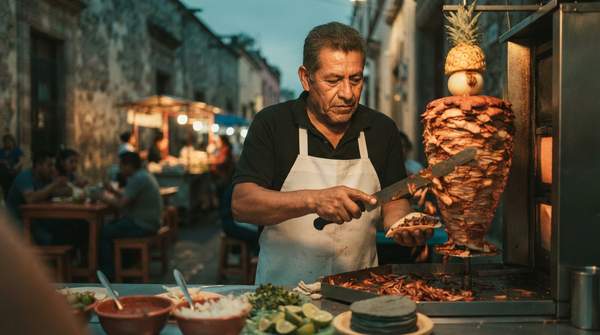
Tacos al pastor exist because of a simple, audacious substitution: Mexican cooks took the vertical spit and stacked lamb of Lebanese shawarma and, over several decades, replaced nearly everything else — the meat, the marinade, the bread, even the toppings. The spinning trompo you see on Mexican street corners today is, in technique, a direct descendant of the shawarma brought by Lebanese immigrants, according to historical accounts of the dish's development in Puebla and Mexico City. What wraps around it — chile-marinated pork, corn tortillas, a shower of pineapple — is entirely Mexican invention.
From Beirut to Puebla: The Shawarma's Mexican Journey
The story begins with migration. Lebanese and other Middle Eastern immigrants settled in Mexico in the late nineteenth and early twentieth centuries, and they brought with them a vertical-roasting tradition: meat stacked on an upright spit, turning slowly beside the heat, carved to order. That technique, and the lamb it cooked, is what we recognize as shawarma. As one account of the trompo's history puts it, tacos al pastor are "a Mexican reinvention of a vertical-roasting tradition associated with Lebanese and other Middle Eastern immigrants who settled in Mexico."
What makes the dish fascinating is how completely the technique survived while everything else changed. The spit — reimagined in Mexico as the trompo — is the one unbroken thread connecting a Beirut-style roast to a Mexico City street taco. As that same account argues, this borrowing does not make pastor any less Mexican; it makes it an example of how Mexican cooking has absorbed and localized outside influences. The vertical grill was the seed; Mexican pantry and palate did the rest.
Tacos Árabes: The First Mexican Adaptation
The first recognizable hybrid emerged in Puebla in the 1930s, when Lebanese immigrants began serving their roast lamb not on the street of a Middle Eastern city but in the Mexican taco format. Tasting Table's account dates this creation to Puebla in that decade: shawarma-style lamb served on a flour tortilla or pita bread, cooked on a vertical grill, and first known as tacos árabes — Arab tacos. A historical write-up on the dish describes the intermediate form simply as "lamb on a flour tortilla."
The name matters. Calling it a taco at all was a concession to the new home; calling it árabe acknowledged where it came from. The bread — pan árabe, a thick flour tortilla similar to pita — was a direct adaptation of Arabic bread, keeping one foot in each culture. Tacos árabes still exist today as their own dish, and Wikipedia's entry describes them as a variation using a combination of Middle Eastern spices and indigenous central Mexican ingredients. The marinade of this intermediate stage is not documented in detail in the historical accounts, which speak only generally of Middle Eastern seasoning.
The Birth of Tacos al Pastor: A Culinary Revolution
The decisive transformation came in the 1960s, and it came from the second generation. According to the historical account, it was the Mexican-born children of the original Lebanese immigrants who opened their own restaurants in Puebla and put a deliberately Mexican twist on the family dish. Three substitutions define the moment: lamb was switched out for pork; the pita or flour tortilla was switched out for corn tortillas; and the meat was marinated in the spices and chilies popular in Mexican cuisine.
The food historian Pilcher, interviewed by the BBC, places the same revolution in the context of a 1960s culinary boom in Mexico City, where trendy restaurants experimented with new tacos. In his telling, the second generation of Lebanese Mexicans "are taking that shawarma technique and then adapting it" — pork instead of lamb, plus a chile marinade — which produced the taco al pastor. The name itself, "shepherd style," tips its hat to the Levantine lamb-herding past even as the lamb disappears. Wikipedia's entry likewise notes that the dish's flavor palette uses a traditional Mexican adobada marinade, and that in parts of northern and coastal Mexico, such as Baja California, the taco is known instead as taco de trompo or taco de adobada.
Culinary Evolution: Shawarma to Al Pastor
Read the history component by component and the fusion becomes concrete. Each row below isolates one culinary decision — meat, marinade, bread, technique — and shows what changed at each stage, from the Lebanese original through the Puebla intermediate to the modern street taco. The marinade row for tacos árabes is left deliberately blank: the surviving accounts describe that stage's seasoning only in general Middle Eastern terms.
| Component | Lebanese Shawarma | Tacos Árabes (1930s, Puebla) | Tacos al Pastor (1960s, Puebla/Mexico City) |
|---|---|---|---|
| Primary meat | Lamb | Lamb (some accounts allow lamb or pork) | Pork |
| Marinade and spices | Middle Eastern spice tradition | Not documented in surviving accounts beyond general Middle Eastern seasoning | Achiote, dried Mexican chiles, garlic, vinegar and pineapple — the traditional adobada palette |
| Cooking method | Vertical spit | Vertical grill (trompo) | Trompo, the same vertical spit, caramelizing the marinated pork |
| Serving vessel | Pita bread | Pan árabe — a thick flour tortilla similar to pita | Corn tortilla |
| Key toppings | Not detailed in the accounts | Not detailed in the accounts | Pineapple, among taco toppings |
The table makes the pattern visible: the technique stayed constant across all three stages while the ingredients localized, step by step. That is the signature of successful culinary fusion — a borrowed structure carrying entirely local content.
The Pineapple Paradox: A Sweet Mystery
And yet the ingredient most people associate with al pastor — the cylinder of pineapple often skewered atop the trompo, its juice flicked onto the sizzling pork — is the one piece of the story nobody can fully explain. The historical account is blunt on this point: "At one point, pineapple began to be included to the taco al pastor recipe. The origins of the inclusion of pineapple remain a food mystery to this day."
That is a rare thing in food history: a defining characteristic with no documented origin story. The sweet-acid cut of pineapple against rich chile pork clearly complements the adobada marinade, but whether it began as one taquero's improvisation in Puebla, a Mexico City restaurant flourish, or something else entirely, no source establishes. The honest answer is that it arrived, it stuck, and it became characteristic — and the rest is speculation. Tasting Table describes the finished product as those pineapple-and-pork tacos served on street corners across Mexico, a reminder that a dish's most iconic element can also be its least documented.
Embracing Culinary Fusion: A Legacy of Adaptation
Appreciate tacos al pastor as a dynamic culinary creation, born from cultural exchange and continuous adaptation — a Lebanese technique, a Puebla intermediate form, and a 1960s Mexican reinvention by the immigrants' own children. The measurable takeaway is recognition: the next time you stand in front of a trompo, you can identify which elements came from where — the vertical spit from the Lebanese shawarma tradition, the pork and adobada marinade from the Mexican pantry, the corn tortilla from the 1960s transformation, and a wedge of pineapple whose origin remains one of the food world's small, pleasant unsolved mysteries.