If you're planning a food-focused trip through Southeast Asia, the honest answer is that there is no single "best" country — there are four distinct night market personalities, and the right one depends entirely on how you like to eat. Travel writers who compare the region side by side tend to land on the same pattern: Thailand is energetic and tourist-friendly, Vietnam is local and chaotic, Malaysia carries its traditional pasar malam culture, and Laos keeps things genuinely laid-back. Here's how each one actually feels, and how to pick.
Introduction: Your Southeast Asian Night Market Adventure Awaits
Every capital in the region boasts what local guides call a legendary food market, each with its own personality. The comparison that matters for trip planning isn't which market has the best single dish — it's the vibe of the whole scene, because that determines whether you'll spend your evenings comfortably fed or gloriously overwhelmed. The framework throughout this article draws on a country-by-country comparison from the travel site House of Routes, which sorts Southeast Asian night markets by who each country suits best, its standout dish, and its atmosphere. Treat these as broad national characters rather than guarantees for any single market.
Thailand: The Energetic First-Timer's Feast
In the House of Routes comparison, Thailand is the country matched to first-timers, with a market vibe described as energetic and tourist-friendly, and mango sticky rice as the standout sweet. Bangkok's Jodd Fairs illustrates the style: according to a guide on ASEAN Tourism by Morgan Hunt, the market began as a train market and evolved into a sprawling, trendy night spot with a clean, organized layout, where white tents and fairy lights create a festival-like atmosphere. That combination — accessibility plus spectacle — is what makes Thailand the classic entry point. You get crowd energy without needing much street-food experience, and the famous desserts are easy entry points for cautious palates.
Vietnam: Freshness and Local Chaos
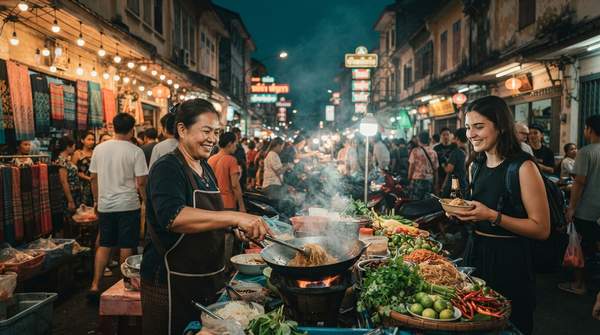
Vietnam is the country House of Routes matches to what it calls "freshness addicts," with banh mi as the signature dish and a market vibe it characterizes as local and chaotic. Ho Chi Minh City shows exactly what that means. A guide to the city's night markets by local travel operator Joy Journeys describes the "organized chaos of the crowd" as a genuinely immersive sensory experience, and stresses that these markets are living parts of the community rather than tourist traps, where locals haggle, snack, and soak up the evening air. The century-old Ben Thanh Market in District 1 anchors the scene: the VietGo guide calls it the city's most iconic landmark and the best place to taste street food while engaging in what it labels "bargaining psychological warfare."
Ben Thanh also rewards timing. The VietGo guide describes the daytime indoor market running from 06:00 to 18:00, after which the surrounding streets — Phan Bội Châu and Phan Chu Trinh — transform into a lively night market with seafood stalls, barbecue stands, and clothing booths, best enjoyed between roughly 18:00 and 22:00 with dinner and beer.
Malaysia: A Fusion of Flavors for Satay Fans
Malaysia's night market identity runs through its pasar malam tradition — literally its night market culture — which is how House of Routes frames the national vibe. The same comparison slots satay fans into the country, pairing satay with roti canai as the dishes to seek out. The appeal is the mix: grilled skewers and flaky flatbread reflect a broader culinary layering that makes Malaysian stalls feel distinct from the noodle-heavy scenes of Thailand and Vietnam. If your ideal evening involves following smoke from a grill and ordering by the skewer, this is your lane.
Laos: Laid-back Charm and Buffet Delights
Laos earns the "chill vibes" label in the House of Routes comparison, described as laid-back, with baguette sandwiches as the surprising standout dish — a legacy of French colonial influence that turns up in unexpected places. The pace here is the draw. Rather than navigating crowds and shouting vendors, you drift, browse, and eat slowly. For travelers who want cultural immersion and a memorable meal without adrenaline, Laos is the low-pressure option — the trade-off is fewer big-name markets and less variety than its louder neighbors.
Navigating the Night Markets: Practical Tips for a Smooth Experience
However you choose, a few habits consistently improve the meal. House of Routes recommends buying one or two small dishes, sharing, then moving on — the sampling strategy that lets you try more in a single night. On stall selection, the same guide notes that busy stalls move ingredients constantly, which means everything is fresh, while slow-moving stalls are worth avoiding for exactly the opposite reason. It also warns against eating only famous dishes, arguing that the best memories come from regional snacks, sweets, sausages, grilled seafood, and dishes you didn't know before arriving.
At markets like Ben Thanh, bargaining is part of the culture: VietGo's guide advises keeping a friendly smile, comparing prices across two or three vendors before deciding, and remembering that turning away often prompts a price drop. The Joy Journeys guide echoes this, calling the markets treasure troves for bargain hunters.
Your Southeast Asian Night Market Decision Framework
To turn these descriptions into a decision, match your traveler profile to each country's documented character. The table below executes that matching using the country comparison and market descriptions above:
| Country | Best For (Traveler Type) | Market Vibe | Signature Dish/Experience |
|---|---|---|---|
| Thailand | First-timers wanting an easy, accessible scene | Energetic, tourist-friendly; Jodd Fairs' organized, festival-like layout | Mango sticky rice (standout), plus the famous pad thai |
| Vietnam | Freshness addicts who thrive on local, chaotic energy | Local and chaotic; "organized chaos" of crowds, deeply embedded in community life | Banh mi, plus seafood stalls and barbecue at Ben Thanh's night market (roughly 18:00–22:00) |
| Malaysia | Satay fans and grill lovers seeking layered flavors | Pasar malam culture — traditional night market tradition | Satay and roti canai |
| Laos | Chill-seekers wanting relaxed cultural immersion | Laid-back, unhurried | Baguette sandwiches |
Read the table as a matching exercise: if your priority is a smooth, comfortable first taste of the region, Thailand's organized energy wins; if you want to eat where locals eat and don't mind sensory overload, Vietnam's chaos is the reward; if skewers off the grill define a perfect night, Malaysia's pasar malam culture is the fit; if you'd rather wander without a plan, Laos delivers the chill.
Ready to Feast: Choosing Your Night Market Destination
The decision is straightforward: choose your Southeast Asian night market destination based on your preferred atmosphere, culinary adventurousness, and desired cultural immersion — energetic and organized for first-timers in Thailand, local and chaotic for freshness addicts in Vietnam, tradition-flavored grill culture in Malaysia, or laid-back wandering in Laos. Note that these are national characters, and any individual market may differ from the pattern. One more consideration from House of Routes: if you can't pick just one, it suggests pairing Thailand, Vietnam, and Malaysia as a core route for a food-focused trip. Your trip is on track when you can name your primary country and the dish or market vibe that pulled you there — and when you're standing in front of a busy stall, sharing a first small plate before moving to the next.
Sources
- Best Night Market Food in Southeast Asia: 34 Dishes to Try — House of Routes
- Asian Street Food: Your Ultimate Guide to Night Markets — Asean tourism
- Ho Chi Minh City Ben Thanh Market Guide | Opening Hours, Must-Try Foods, and Bargaining Tips — VietGo
- Night Market Ho Chi Minh City: A Shopper's & Foodie's Guide — Joy Journeys