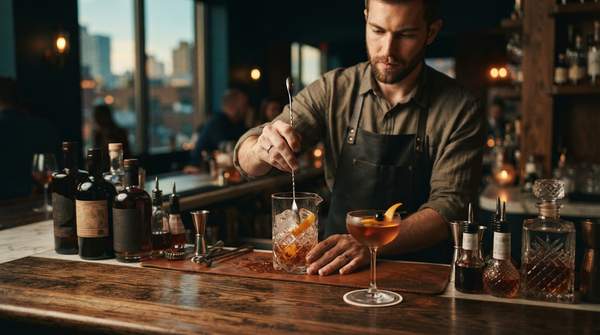
The fastest way to stop following recipes and start designing drinks is to borrow how professionals think. Nik Sparks, head bartender at The Wooly, breaks any classic down into four qualities—ingredients, technique, taste, and presentation—and modifies with intention rather than guesswork. His Black Manhattan, for instance, keeps a Manhattan's bones while swapping in amaro and liqueurs that push it toward espresso and Italian wedding cookies. Here is that framework, and how to use it at your own bar.
Nik Sparks' Four-Part Framework for Cocktail Modification
Sparks' method begins with a question, not a substitution: "What do I like most about [fill in the blank] drink?" His answer, he says, "usually has to be some combination of at least two, if not three" of the drink's core components. In other words, identify what makes the classic recognizable before you touch anything. Once you know the drink's foundation, you can alter it across four dimensions: what goes in the glass, how it's made, how it tastes, and how it looks. Each dimension is a separate lever, and pulling one at a time keeps your experiment legible.
Modifying Ingredients: The Foundation of Flavor
The most accessible lever is a like-for-like swap. The Wooly's Black Manhattan replaces sweet vermouth with Averna amaro, keeping the rye whiskey and bitters in place. The structure of the drink—spirit, bitter-sweet modifier, bitters—survives intact; only the flavor character shifts. Toronto hospitality expert Evelyn Chick, owner of Love of Cocktails, works the same way, and her Smoked Maple Old-Fashioned simply trades simple syrup for smoked maple syrup, finishing the drink with plum and root beer bitters. The lesson: change one ingredient in a category, keep the ratio, and the classic remains recognizable while becoming something new.
Altering Technique: Enhancing the Experience
Technique changes how a drink arrives at the senses, not just what it contains. The clearest example is smoke. A reimagined old fashioned described by Regatta Grove is infused by capturing the smoke of burning oak chips under a glass dome—an aromatic flourish that elevates the drink without overwhelming its classic flavors. Chick's smoked maple syrup achieves a similar effect through the ingredient itself rather than the vessel. Technique can be as simple as how you integrate a component: infusing a syrup, smoking a finished drink, or choosing to stir rather than shake. The point is that preparation is a creative variable, not a fixed step.
Adjusting Taste Profile: Crafting New Sensations
Taste is where you decide what the drink should feel like. Sparks' full version of the Black Manhattan retains rye, amaro, and bitters, then introduces coffee and almond liqueurs chosen deliberately to complement the amaro's orange and licorice notes. The result, he says, delivers "the peppery, warm sensation you get from a Manhattan, but includes notes of espresso and Italian wedding cookies." Notice the reasoning: the additions weren't random, they were selected because they harmonize with an existing flavor. When adjusting taste, ask what note is missing or what note you want to amplify, then add an element that speaks to what's already in the glass.
Enhancing Presentation: The Visual Appeal
Presentation is the dimension home bartenders most often skip, yet it shapes the drink before the first sip. The smoked old fashioned pairs its oak-chip dome with a charred orange peel and a whiskey-soaked cherry—garnishes that reinforce the smoky theme rather than decorate around it. A garnish works hardest when it echoes a flavor already present: the charred peel extends the smoke, the cherry adds richness in the same register as the bourbon. Glassware and visual drama count too. The dome of smoke is as much theater as flavor, and that anticipation is part of the experience.
Your Cocktail Modification Decision Framework
Use this matrix to deconstruct any classic and generate one deliberate idea per dimension. Pick a drink you know well, fill in each row, and you'll have four reasoned variations to test—each changing a different element, so you can taste what each change actually does.
| Quality to modify | Modification principle | Example from the experts | Impact |
|---|---|---|---|
| Ingredients | Swap one component for a similar one in the same category; keep the ratio | Black Manhattan: Averna amaro in place of sweet vermouth | New flavor character while the drink's structure holds |
| Technique | Change how the drink is made or finished | Smoked old fashioned: oak-chip smoke captured under a glass dome | Aroma and sensory experience beyond taste alone |
| Taste | Add an element chosen to complement existing notes | Coffee and almond liqueurs layered onto the amaro's orange and licorice | Espresso and cookie notes over the Manhattan's warm, peppery base |
| Presentation | Make the garnish echo the drink's flavors | Charred orange peel and whiskey-soaked cherry on the smoked old fashioned | Visual drama that reinforces the theme before the first sip |
One guardrail from the professionals: keep the classic visible. Mixologist advice collected by CBC Life puts it plainly—"make sure the cocktail still resembles, and is recognizable as, the classic itself." A riff that loses its ancestor isn't a variation; it's a different drink.
Your Turn: Applying the Framework to Your Home Bar
Sparks recommends starting with simple cocktails that have easy ratios, because they provide strong foundations for many variations. An old fashioned or Manhattan—spirit, sweetener, bitters—gives you fewer variables to control and clearer feedback on each change. Work one dimension at a time, taste, and note what shifted. Not every experiment will succeed; that's inherent to the method, not a failure of it. And remember that this framework transmits working bartenders' advice, not a guarantee—the judgment about balance stays with your palate.
Elevate Your Home Mixology: The Path to Personalized Drinks
Apply the four-part framework—ingredients, technique, taste, presentation—to systematically experiment with classic cocktail recipes rather than substituting at random. The measurable indicator of success is creating a personalized variation that is balanced and enjoyable, and being able to articulate the specific modifications you made and their intended impact. When you can say "I swapped the vermouth for amaro to deepen the bitter edge, and it worked," you've stopped following recipes and started designing drinks.