Here's the short answer before anything else: the difference between memorable pasta and mediocre pasta is often decided in the drying room, hours or even days before the water boils. Traditional slow drying holds durum wheat pasta at low temperatures over an extended period, preserving its protein structure and starch behavior so the noodle cooks firm, bites with that elastic al dente snap, and carries a slightly coarse surface that sauce can cling to. Modern fast drying uses high or very high temperatures to finish the job in a fraction of the time, and the heat leaves fingerprints: chemical markers of protein damage appear, and the eating experience changes. Once you understand the mechanism, you can read a package and a plate with new eyes.
The Art of Drying: Why Pasta Quality Starts Before the Boil
Dried pasta is just durum wheat and water, which makes the drying step deceptively important. A narrative review of the pasta-making process, published in the research collection of the National Library of Medicine, lists drying among the process variables that directly shape pasta structure and quality, alongside extrusion conditions and die material. The review connects drying specifically to two measurable outcomes: gluten tenacity and starch pasting properties. In other words, how you remove the water from a shaped noodle helps determine what its protein network and its starch can do later, in the pot.
Why would a producer rush it? Time is money. As pasta maker Meryl Feinstein explains in her guide to dried pasta, fast drying lets producers make more pasta in less time, which is why it dominates industrial production. Artisanal makers counter that slow drying better preserves the wheat's flavor and nutrients and yields a superior texture. The Italian producer Benedetto Cavalieri, for instance, has built its reputation around what it calls the metodo delicato, or "delicate method," pairing low-temperature drying with an intentionally slow production pace.
Traditional Slow Drying: Preserving Structure for Superior Texture
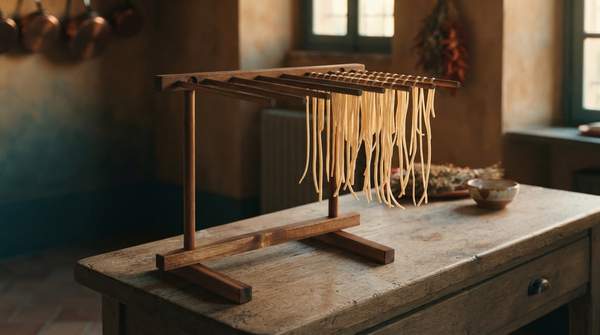
Traditional slow drying is a deliberate, gradual process over many hours to days, with the exact duration depending on the pasta's type and thickness. The Pasta Tree, an artisanal producer documenting its process, describes the method as air-based and unhurried, in contrast to modern high heat and mechanical dryers. The payoff, the producer argues, is pasta that avoids brittleness and retains its authentic taste.
The science behind that claim centers on gentleness toward the pasta's molecules. Writing for Gusta, Alberto Giannetti explains that slow-dried pasta uses a Low Temperature–Long Time process below 140°F (about 60°C). At those temperatures, the protein matrix that holds the noodle together is left largely intact. The National Library of Medicine review notes that drying influences gluten tenacity and starch pasting properties, and that a regular, undamaged protein structure is essential for good cooking behavior. Slow drying keeps both the gluten network and the starch's natural pasting properties in their desirable state.
Modern Fast Drying: The Trade-offs of High Heat
Fast drying flips the equation: High Temperature–Short Time, or Very High Temperature–Short Time, processes drive moisture out quickly so more pasta can leave the line each day. The cost is thermal damage to the pasta's proteins. Giannetti points to furosine as the evidence. Furosine is an amino acid derivative formed in the early stages of the Maillard reaction, when reducing sugars react with the amino group of lysine in proteins; in simple terms, it indicates the extent of protein damage from thermal processing, especially excessive heat.
According to the research Giannetti summarizes, many slow-dried pastas show lower furosine levels than pastas dried quickly at high or very high temperatures. That matters for two reasons. Nutritionally, lower furosine points to better-preserved protein quality and digestibility. Culinarily, a protein network that has been chemically altered by heat behaves differently when cooked, and that difference shows up on the plate rather than only in the lab.
Slow vs. Fast Drying: A Comparative Look at Pasta Quality
This table contrasts the two processes across their key variables, from temperature to what ends up on your fork.
| Dimension | Traditional Slow Drying | Modern Fast Drying |
|---|---|---|
| Drying method | Gradual, deliberate process over hours to days; duration depends on pasta type and thickness | High Temperature–Short Time or Very High Temperature–Short Time processes |
| Temperature | Low temperatures, below 140°F (about 60°C); often called metodo delicato or slow drying | High or very high temperatures used to finish drying quickly |
| Effect on protein | Preserves protein quality and structural integrity; lower furosine levels reported in many slow-dried pastas | Thermal processing can damage proteins, increasing furosine, an early Maillard-reaction marker of protein damage |
| Effect on starch | Maintains desirable starch pasting properties, which the research review links to overall pasta quality | Intense heat treatment alters the pasta's molecular structure compared with low-temperature drying |
| Resulting texture | Firm, al dente bite with uniform cooking; avoids brittleness | Cooking behavior can differ as protein structure is modified by heat |
| Sauce adherence | Slightly coarse surface conducive to sauce adherence | Surface character depends on the process; slow drying's adherent roughness is not guaranteed |
The comparison reveals the underlying logic: every quality attribute traces back to how gently the water was removed. Slow drying protects the molecules; fast drying trades some of that protection for throughput.
From Structure to Plate: How Drying Affects Al Dente and Sauce Adherence
What do these molecular differences actually feel like at dinner? The Pasta Tree describes properly dried pasta as exhibiting a firm texture, a slightly coarse surface conducive to sauce adherence, and the golden hue characteristic of durum wheat. Pasta dried by traditional methods also cooks more uniformly and holds its al dente quality.
Connect that description back to the science and the story completes itself. A preserved protein network gives the noodle its tenacious, elastic bite; intact starch keeps the cooking behavior predictable rather than sticky or uneven. The slightly rough surface is where sauce physically anchors, which is why a slow-dried noodle can carry a thin sauce and still deliver flavor in every bite. Giannetti offers a practical test for noticing these differences: cook pasta in bianco, with just butter, cheese, and starchy pasta water, and let the noodle itself do the quiet work. Strip away the sauce, and texture, bite, and surface become impossible to miss.
Shopping Smart: Identifying Quality Dried Pasta
Here is the honest difficulty: unlike ingredients or bronze-die extrusion, drying methods are not always printed on the package, as Feinstein warns. The words can be harder to find than semola di grano duro. So how do you shop for it?
Look for explicit claims first. Labels or producer websites that mention "slow dried," "lenta essiccazione," or "metodo delicato" signal a low-temperature, long-time process, in the style of Benedetto Cavalieri's declared method. Producers who take pride in slow drying usually tell you so, which is itself informative; silence about drying is a soft indicator of a conventional fast process. Then let the package and the plate confirm each other: a golden durum hue and a matte, slightly rough surface in the box, followed by a firm, non-sticky, sauce-clinging bite in the pan, are the observable outcomes the slow method is celebrated for. This article focuses on dried durum wheat pasta; fresh pasta and other grains follow different rules.
Choosing Your Pasta: A Guide to Informed Decisions
When purchasing dried pasta, prioritize products that indicate slow, low-temperature drying methods to ensure superior texture, al dente cooking performance, and optimal sauce adherence. The brand name on the box tells you far less than the process behind it, and the process is often declared in plain language by the makers who are proud of it.
Your measurable indicator: look for packaging labels such as "lenta essiccazione," "metodo delicato," or explicit mentions of low-temperature drying, and observe if the cooked pasta maintains a firm, non-sticky texture with good sauce cling. Run the in bianco test on your next box: butter, cheese, starchy water, nothing else. If the noodle still tastes like something and the sauce clings instead of pooling, you have found your producer. That one pan of pasta, compared against your usual grocery brand, is the simplest experiment you can run, and the only ranking that matters.