When you slurp a bowl of thick, glossy udon, you're tasting roughly eight centuries of adaptation. The noodle we now think of as quintessentially Japanese began as a Chinese knife-cut noodle called kirimugi—"cut wheat"—introduced in the early 1200s. It found its footing in temple kitchens, gained refinement as milling and cutting techniques matured, and by the late eighteenth century had become fast food on the streets of Osaka. Let me walk you through how that happened.
The Ancient Roots: Udon's Introduction to Japan
The story starts with a very specific noodle. Kikkoman's food-culture account traces udon's Japanese origins to knife-cut noodles brought from China in the early 1200s. These were slender affairs—about two millimeters wide—called kirimugi. And they weren't eaten the way we eat udon today: the noodles were boiled, rinsed and cooled, then dipped into a cold, clear sauce called taremiso, made by mixing miso with water, boiling it down and straining it through cloth.
So the earliest "udon" looked quite different from the fat strands in a steaming bowl of broth. What carried over was the essential idea—wheat dough, rolled and cut into noodles—that Japanese cooks would spend the following centuries reshaping into their own. A separate historical account from JPNEAZY places udon's early production in the Edo period, tied to Chinese noodle culture arriving through maritime trade, with temples and vegetarian kitchens making the noodles to serve monks and devotees. That monastic origin matters: udon began as a modest, practical food before it became a beloved one.
Evolution of Craft: From Coarse Flour to Refined Noodles
Why does udon have that distinctive chew and pliability? The answer is largely technological. Early udon was made with coarse wheat flour, which limited what the noodle could be. As flour milling techniques improved over the Edo period and beyond, finer flour became available, and makers used it to create a more delicate noodle.
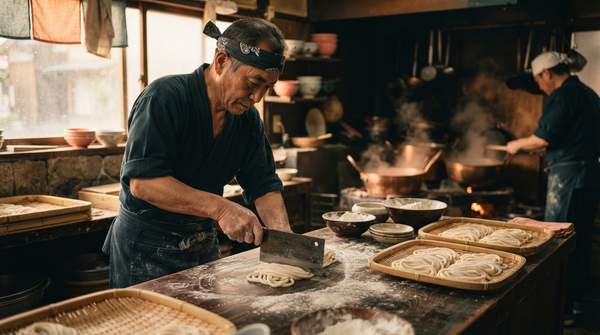
The dough itself evolved too. JPNEAZY's historical account describes continuous refinement in both dough mixing and noodle cutting, producing a texture that was more uniform and pliable than earlier versions. Kikkoman's account adds a telling detail: the tool used to cut udon is a dedicated knife called an udon-kiri. Precision cutting wasn't an afterthought—it was built into the craft's toolkit. In other words, the udon we recognize today is not one invention but a long, steady accumulation of small improvements: better flour, better mixing, a sharper and more disciplined blade.
Udon's Rise as a Popular Staple in the Edo Period
By the late eighteenth and early nineteenth centuries, udon had left the temple and entered the street. According to Kikkoman's account, udon became a popular fast food in Osaka, then the commercial center of the country, with shops serving noodles in hot broth—a fundamentally different consumption style from the cold kirimugi dipped in taremiso. Around this same period, ordinary soy sauce came into use in the soup.
That shift is worth pausing on. A noodle once confined to monastic kitchens became affordable, quick, and available to ordinary city dwellers. JPNEAZY's account echoes this trajectory, noting that the dish became popular and loved by the people and grew into an integral part of Japanese cuisine. The popularization continued into the twentieth century, when modern transportation and cold-chain technology made udon easier to produce and sell, and traditional udon shops began springing up all over Japan. What started as a regional Osaka convenience became a national staple.
Regional Identities: Osaka's Dashi and Kagawa's Sanuki Udon
Here's what I find most fascinating: as udon spread, it never standardized. Kikkoman's account notes that udon is enjoyed throughout Japan, but its cooking styles and soup flavors differ by region—broadly speaking, the soup is lighter in color in the western part of the country and darker in the east and north.
Osaka remains the standard-bearer for the soup itself. What has long distinguished udon in Osaka, per Kikkoman, is its dashi—a complex blend of high-quality kombu from Hokkaido and katsuobushi, along with other dried fish flakes such as mackerel and mejika, a species of bonito. Osaka noodle makers have long mixed local and regional Japanese wheat to make special udon flour, but it's the strong umami of that dashi that defines the bowl. Meanwhile, Kagawa Prefecture, home of the famous Sanuki udon, is known for self-serve shops where diners select their own toppings after receiving their noodles—a serving style that makes the meal as customizable as it is quick. Same noodle, two very different regional philosophies.
Key Milestones in Udon's Historical Evolution
To see the full developmental path at a glance, here is the chronology assembled from the historical accounts above, sequenced from introduction to regional differentiation.
| Date/Period | Key Development | Description |
|---|---|---|
| Early 1200s | Introduction of kirimugi from China | Knife-cut noodles about two millimeters wide, boiled, cooled, and dipped in taremiso sauce. |
| Edo period | Temple production | Udon tied to Chinese noodle culture via maritime trade; made by temples using coarse wheat flour for monks and devotees. |
| Edo period onward | Technique refinement | Improved milling brought finer flour; more precise dough mixing and cutting with the udon-kiri produced a uniform, pliable texture. |
| Late 18th – early 19th century | Popularization as fast food | Udon shops serving noodles in hot broth emerged in Osaka, then Japan's commercial center; soy sauce entered the soup. |
| Late 18th century onward | Osaka's dashi identity | Osaka udon distinguished by a complex dashi of Hokkaido kombu, katsuobushi, mackerel, and mejika flakes. |
| Modern era | National spread and regional styles | 20th-century transport and cold-chain technology spread shops nationwide; Kagawa's Sanuki udon became known for self-serve topping shops. |
Reading the timeline this way, the pattern is clear: each era contributed something structural—the noodle itself, then its texture, then its serving style, and finally its regional character.
Understanding Udon's Enduring Legacy
Readers should appreciate udon not just as a dish, but as a culinary tradition shaped by centuries of innovation and regional adaptation. The takeaway decision for any curious eater: the next time you encounter a bowl—whether Osaka's dashi-forward style or a Kagawa-style shop where you pick your own toppings—recognize it as one chapter in a story that began with millimeter-wide kirimugi in the thirteenth century.
The measurable indicator of understanding is simple: the reader can identify the historical period and key technical advancements associated with different udon characteristics or regional styles. If you can place the temple-era coarse-flour noodle in the Edo period, the fast-food broth bowl in late-eighteenth-century Osaka, and today's nationwide spread in the twentieth century, you've grasped exactly how this noodle became what it is.
Sources
- Japanese Noodles (No. 2) — Kikkoman Corporation
- Exploring the Delicious World of Japanese Udon Noodles — JPNEAZY