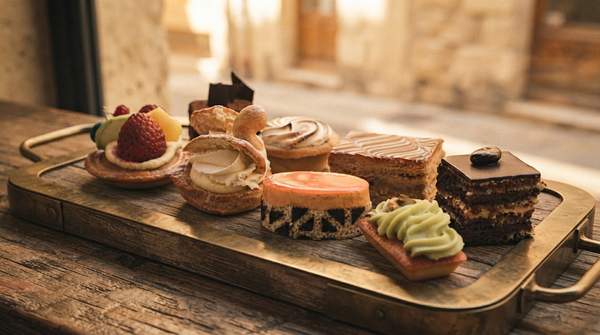
Here's the short answer before we dive in: a croissant is defined by butter laminated into yeast dough, an éclair by hollow choux pastry piped into a long shape and filled with cream, a macaron by delicate almond-meringue cookies sandwiched around ganache, and a Tarte Tatin by apples caramelized under pastry and flipped before serving. If you're deciding which one to bake next, the choice really comes down to which of those four building blocks excites you most. Let me walk you through each one.
Croissant: The Laminated Classic
The croissant earns its reputation the hard way. It's a yeast-raised pastry, and what makes it distinct is the folding: butter is worked into the dough and the two are folded and rolled together repeatedly, building many thin, alternating layers. One description I came across put it memorably—the croissant is "essentially a small mountain of butter folded into the dough." That lamination is the whole personality of the thing.
When the croissant bakes, those butter layers do the work, producing the airy, flaky, buttery texture the pastry is known for. And here's a point worth savoring: while you'll find croissants filled with chocolate, almond cream, or fruit, the plain croissant genuinely stands on its own. For a home baker, this is the pastry where the dough itself is the star—there's nowhere to hide, and no filling to rescue you.
Éclair: The Choux Pastry Delight
The éclair plays a completely different game. Its foundation is choux pastry, a light dough that puffs up dramatically in the oven, leaving a hollow interior. That emptiness isn't a flaw—it's the entire design. The pastry is piped into an elongated shape, baked until it forms that airy shell, and then filled.
The classic presentation is a vanilla-based pastry cream finished with chocolate icing, though bakers have riffed on the combination since the éclair's creation, working in coffee and caramel flavors among others. New York bakeries have taken the idea even further—one shop's ube éclair swaps in purple yam cream, listed at around $9 to $11. Choux is also a wonderfully economical skill: the same dough forms the base for profiteroles, the small round puffs that share the éclair's filling logic but not its shape.
Macaron: The Delicate Meringue Cookie
The macaron is the odd one out here, because it isn't built on a dough at all. It's a meringue-like cookie made with ground nuts—almond flour, egg whites, and sugar—producing a base that is delicate by nature. Two of these cookies get sandwiched together with cream or ganache to form the finished treat.
The filling matters as much as the shell. Ganache, made by combining chocolate and cream, sits at the heart of many French desserts, and its success hinges on the quality of the chocolate, which dictates both flavor complexity and smoothness. Fruit-based fillings and real fruit purees bring vibrant flavors that complement the almond base. The results are famously colorful—green pistachio, pink strawberry—flavored and tinted to the eater's delight. If precision and a light, sweet, gluten-free-friendly base appeal to you, this is your pastry.
Comparing Iconic French Pastries for Home Bakers
Now let's put all four side by side. Reading them across the same three attributes—dough, filling, construction—makes the structural differences jump out: the croissant's layers come from folding, the éclair's cavity from steam-puffed choux, the macaron's sandwich from meringue, and the Tarte Tatin's character from caramelization under pastry.
| Pastry | Defining Dough/Base | Typical Filling(s) | Basic Construction |
|---|---|---|---|
| Croissant | Yeast-raised dough laminated with butter in thin layers | Often plain; variations include chocolate, almond cream, or fruit | Dough repeatedly folded and rolled with butter, then baked to a flaky finish |
| Éclair | Choux pastry—light, hollow when baked | Pastry cream, classically vanilla; chocolate icing on top | Piped into an elongated shape, baked until hollow, then filled and iced |
| Macaron | Meringue-like cookie of ground nuts, egg whites, and sugar | Cream or ganache, including chocolate and fruit-based fillings | Two delicate cookies sandwiched around the filling |
| Tarte Tatin | Pastry—commonly pâte brisée, pâte sablée, pâte sucrée, or puff pastry, with puff pastry a traditional choice | Apples cooked with butter and sugar (Granny Smith appears in one common version) | Apples caramelized with butter and sugar, covered with pastry, baked, then flipped before serving |
These four also represent different branches of the French pastry tradition. The croissant belongs to viennoiserie—the yeasted, breakfast-style pastries—while the éclair, macaron, and Tarte Tatin fall under pâtisserie, the broader world of sweet pastries built on choux, meringue, and tart doughs respectively. Knowing the family helps you predict what other pastries will ask of you once you've learned one.
Choosing Your Next French Baking Adventure
So which one should you pick? Home bakers can select a French pastry to explore based on their interest in specific dough types, fillings, and construction methods—and the table above is your decision map. If you're drawn to dough as craft, choose the croissant and its lamination. If you want a dramatic transformation in the oven, the éclair's puffing choux delivers it. If delicate, colorful, filling-forward work appeals, the macaron is your project. And if you'd rather master caramel and a single confident flip than fuss with layers, the Tarte Tatin rewards exactly that.
One honest caveat: this is a descriptive comparison, not a recipe guide. It deliberately skips difficulty ratings, step-by-step techniques, and preparation times, and it covers only these four pastries. Use it to choose a direction, then find a dedicated recipe for your pick.
Your measurable indicator of success is simple: the home baker successfully identifies a pastry that aligns with their baking interests and feels confident in understanding its fundamental characteristics. When you can say why a croissant is flaky, an éclair is hollow, a macaron is delicate, and a Tarte Tatin is caramelized—and point to the one you're baking next—you've gotten everything this comparison can give you.
Sources
- Six Types of French Pastries to Try in NYC — Frenchy Coffee NYC
- The Importance of High-Quality Ingredients in French Pastry — Patisseriealacarte
- 5 French Pastries Ranked From Delicious to Delightful — AESU Travel