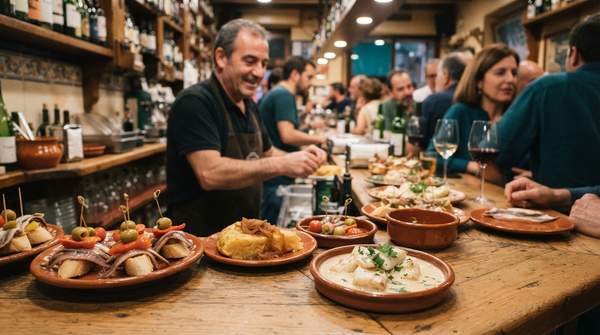
Tapas began with a practical problem: flies in the wine. In southern Spain's hot climate, drinkers covered their glasses, and that humble "cover"—the tapa—grew into one of the world's most admired ways of eating. But tapas is not one tradition; it is many. As the custom spread north from Andalusia, each region adapted it to local ingredients and social habits, producing distinct styles you can still taste today.
The Practical Origins of Tapas: From Cover to Culinary Custom
As culinary historians recount it, tapas started in Andalusia, where hot weather made wine-drinking a magnet for flies, and a lid over the glass was simply sensible. Cured ham, olives, and bread soon did double duty as both practical cover and an excuse to linger. The word itself most likely descends from the tapadera, the lid placed on the glass.
That account, however, is legend as much as history. Writers tracking the tradition note at least four origin stories, all involving Spanish royalty and an improvised jamón cover at a southern tavern, none supported by documentary evidence. When Spain formally pursued cultural heritage recognition for tapa culture, the official submission included an "Origin Legends" section—treating the stories as part of the record rather than settled fact. The custom then spread with travelers and traders, reaching Madrid, Barcelona, and the Basque Country, where each region reworked it with local ingredients.
Andalusia: The Birthplace of Tapas and Its Simple Pleasures
Andalusia remains the tradition's touchstone. The region's staples—olives, ham, and olive oil—became early tapa standards, and seafood from its long coastline soon followed. Dishes like pescaíto frito (fried fish), boquerones (vinegar-marinated anchovies), eggplant with honey, and small montadito sandwiches capture the style: simple ingredients, generously given.
The signature custom here is the free tapa that arrives with your drink, a courtesy that turns ordering a caña into a small culinary surprise. As one account of the tradition notes, this complimentary practice was once common in cities with students and cattle markets, such as Salamanca and Santiago de Compostela, before spreading more widely—though today many bars offer only small accompaniments, so expectations should be calibrated bar by bar.
Basque Country: The Art of Pintxos and Culinary Innovation
In the north, the Basque Country built its own distinct tradition: pintxos. The name comes from how they are served—pierced, "pinchado," on a cocktail stick or skewer. As historian Almudena Villegas explains, these snacks are "arranged artistically on the counter on large trays or plates" to whet the customer's appetite, turning the bar top itself into a display case.
The customs differ sharply from the south. You choose your pintxos yourself, pay per piece, and typically eat them standing up. The bar is filled with elaborate skewered creations, often built on bread and featuring premium ingredients such as Ibérico ham and aged cheeses. The emphasis is as much visual as gustatory—flavor and presentation in equal measure—making a Basque bar crawl as much a gallery visit as a meal.
Catalonia and Madrid: Regional Adaptations and Urban Sophistication
Catalonia leans into its Mediterranean identity. Its tapas often begin with pan con tomate—bread rubbed with tomato—and move through roasted-vegetable escalivada, shredded cod salad (esqueixada), and Catalan sausage (botifarra). The line between a small tapa and a larger ración is less rigid here than elsewhere, so a Catalan tapas outing can shade easily into a full meal.
Madrid, the capital and a self-described melting pot, draws tapas from every region and adds robust, meat-forward plates of its own: callos (tripe stew) and huevos rotos (broken eggs over potatoes) are characteristic examples. The free-tapa custom associated with Andalusia appears here too, though it varies between establishments, and the social ritual of moving from bar to bar—the tapeo—is very much the point.
Regional Tapas Traditions at a Glance
Comparing the four regions side by side shows how the same basic idea—small food with a drink—diverges by geography. The table below contrasts each region's defining name and serving custom, its typical ingredients, and signature dishes. Note that these are representative examples rather than exhaustive menus, and specific customs can vary between individual bars.
| Region | Defining Custom / Name | Typical Ingredients | Example Dishes |
|---|---|---|---|
| Andalusia | Birthplace of the "cover" tradition; tapas often served free with a drink (varies by bar) | Olives, olive oil, ham, abundant seafood, local vegetables | Pescaíto frito, boquerones, eggplant with honey, montaditos |
| Basque Country | Pintxos—named for the skewer; chosen yourself, paid per piece, eaten standing | Ibérico ham, aged cheeses, seafood, high-quality produce, artful presentation | Elaborate skewered creations, often on bread |
| Catalonia | Mediterranean style; flexible line between small tapas and larger raciones | Tomato, roasted vegetables, cod, Catalan sausage | Pan con tomate, escalivada, esqueixada, botifarra |
| Madrid | Melting-pot capital; free tapas common but varies; strong bar-hopping (tapeo) culture | Meat-forward ingredients drawn from all regions | Callos, huevos rotos |
Read this way, the table delivers a simple planning logic: in the south, expect generosity with your glass; in the north, expect to pay per skewer and eat on your feet; in Catalonia, expect Mediterranean produce; in Madrid, expect everything at once.
Modern Tapas: Evolution Beyond Tradition
Tapas have not stood still. The boom of gourmet miniature cuisine has pushed the format to the height of culinary creativity: high-end restaurants and gourmet tapas bars now serve small plates built from premium ingredients with avant-garde techniques—while, as commentators on the trend emphasize, "always maintaining the essence of tapas: small plates made to be enjoyed."
Modern Spanish chefs experiment with sous-vide cooking, molecular gastronomy, and fermentation to reinterpret classic dishes, and those innovations travel with them as they open restaurants abroad. Food writer Jeffrey Alford's assessment captures the scale of the change: "Tapas have become Spain's greatest culinary export, changing how the world thinks about dining, drinking, and socializing." The tradition is even celebrated internationally—since 2013, Spain has marked World Tapas Day annually, promoted by TURESPAÑA and Saborea España to internationalize the concept.
Embracing the Tapas Experience: A Traveler's Decision
To fully appreciate Spanish tapas, travelers should explore the distinct regional variations, understanding that each offers a unique culinary and social experience shaped by local history and ingredients. The practical takeaway is straightforward: match your expectations to the region. In Andalusia, savor the free tapa with your drink; in the Basque Country, budget per pintxo and stand at the counter; in Catalonia, let tapas slide into a full meal; in Madrid, bar-hop through the capital's assembled traditions.
A successful tapas journey is measurable: the traveler successfully identifies and engages with the characteristic tapas customs and dishes in at least two different Spanish regions during their trip—say, a free montadito in a Seville bodega and a paid-per-skewer pintxo in a Bilbao bar. Experiencing that contrast firsthand is the clearest proof that a single, practical cover for a wine glass became a national—and now global—way of eating. And if your itinerary can only fit one region, let it be two.
Sources
- What Are Tapas? The Real Story Behind The Spanish Food Tradition — Blank Palate
- The History of Tapas: From Spanish Bars to Global Phenomenon — Gastronomic Arts Barcelona
- The Spanish Small Plates Revolution: How Tapas Culture Conquered Global Dining - Associated Clinic of Psychology
- All About Spanish Tapas: History, Tradition, and Types — Yourspanishcorner
- The Art of Tapas - Google Arts & Culture