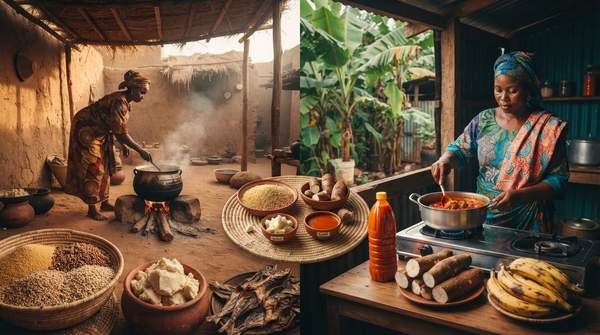
West African cuisine is not a single tradition but at least two distinct culinary worlds, divided broadly by climate. In the dry Sahel, cooks reach for shea butter and grain-based staples; along the humid coast and forest belt, palm oil gives food its signature color and texture, served alongside pounded roots like cassava. Understanding that divide—and the history that carried these ingredients across the Atlantic—is the key to appreciating a cuisine that is finally receiving international attention.
Culinary Zones: Sahelian vs. Forest and Coastal
Geography does most of the work in explaining West Africa's culinary map. The Sahel, the semi-arid belt stretching across the region's northern reaches, favors hardy crops and preservation-friendly cooking. The coastal and forest zones to the south, with their humidity and rainfall, support moisture-loving plants such as cassava, yams and plantains, and provide the oil palms that define the region's most recognizable flavors.
The clearest marker of the divide is the cooking fat. Palm nut oil, traditionally associated with the coastal regions, contributes a distinctive color, flavor and texture to food, according to the region's culinary traditions as documented in encyclopedic coverage of West African cuisine. In the Sahel, shea butter takes its place—called karité in French, a word derived from the Arabic ghartī—and is prized for the rich mouthfeel it imparts.
Comparing West Africa's Culinary Zones
The table below classifies the two zones by their defining attributes, showing how climate shapes what ends up on the plate. Where evidence is strongest—cooking fats and geography—the contrast is sharp; staple crops reflect the general agricultural patterns of each zone.
| Culinary Zone | Climate and Geography | Primary Cooking Fat | Common Starches | Representative Dishes |
|---|---|---|---|---|
| Sahelian Zone | Arid and semi-arid belt; drier conditions limit crops to hardy grains | Shea butter (karité), prized for its rich mouthfeel | Millet and sorghum, suited to dry conditions | Grain-based porridges and couscous-style dishes |
| Forest and Coastal Zone | Humid coast and forest belt supporting root crops and oil palms | Palm nut oil, giving a distinctive color, flavor and texture | Cassava, pounded into fufu; yams and plantains | Fufu with egusi soup; Ghanaian peanut soup |
Reading the table as a diagnostic rather than a menu, the pattern is consistent: fat follows the landscape. Shea trees thrive in the dry savanna, oil palms in the wet south, so the cooking fat on a plate is often the quickest clue to where a dish comes from.
Characteristic Ingredients and Cooking Techniques
Beyond the fats, the coastal zone's best-known dishes illustrate the region's characteristic combination of pounded starches and rich, seed- or nut-based soups. Fufu—pounded cassava—might be sunk into the center of a bowl of Ghanaian peanut soup, or served alongside egusi soup, a Nigerian household favorite made from ground melon seeds and described by Responsible Travel's West African food guide as protein-rich. These pairings of a bland, starchy ball with a deeply flavored soup are the structural grammar of many West African meals.
The techniques behind them are labor-intensive and, until relatively recently, largely unwritten. According to the same travel guide's coverage, methods were passed down in kitchens and cooking spaces, traditionally from grandmothers and mothers to daughters and granddaughters, with many dishes created from involved processes that were not recorded in cookbooks. That oral transmission is one reason the cuisine's regional nuances remain so tied to family and locality rather than standardized recipes.
West African cooking also shares a foundational aromatic base with other world cuisines. The region's essential sautéed trio of ingredients—considered an essential and even "sacred" cooking technique—is analogous to the holy trinity of Cajun and Creole cooking in the United States, sofrito in the Spanish-speaking world, soffritto in Italy, and the mirepoix of France. The comparison is a reminder that West African cooking is a fully developed classical tradition with its own flavor architecture, not merely a collection of dishes.
How History Carried These Flavors Abroad
West African cuisine's influence extends far beyond the continent, and the mechanism was tragic. During the trans-Atlantic slave trade, slave ships carried West African ingredients to the New World, including black-eyed peas, West African rice, roselle, ackee, garden egg, palm oil and okra. These ingredients became foundational to foodways across the Americas, from the American South to the Caribbean, embedding West African culinary DNA in dishes far from their origin.
Colonialism complicated the picture in a different way. Around the colonial period, particularly during the Scramble for Africa, European settlers drew borders without regard to pre-existing territories or cultural differences. This bisected ethnicities and created colonies with varying culinary styles—so much so, as encyclopedic accounts of the cuisine note, that it remains difficult to sharply define something like Senegalese cuisine. The modern national labels on West African food are, in part, colonial impositions on older, more fluid regional traditions.
A Cuisine Gaining Global Recognition
That fluidity is now becoming a strength. As diaspora chefs and food writers document and celebrate these traditions—recovering techniques that were long transmitted orally rather than written down—West African food is moving from family kitchens into the global culinary conversation. The same labor-of-love character that once kept dishes unwritten is now part of what makes the cuisine compelling to international audiences seeking depth and story in their food.
Exploring West African Flavors: A Culinary Journey
To fully appreciate West African cuisine, focus on understanding its distinct regional variations and the historical context that shaped them, rather than viewing it as a monolithic entity. The region's food is best understood as a set of climate-driven traditions—shea butter and grains in the Sahel, palm oil and pounded roots on the coast—layered with a history that spread its ingredients across the Atlantic and blurred its colonial-era borders.
A practical test of that understanding: the reader can identify the primary cooking fat and staple starch of a West African dish and correctly associate it with either the Sahelian or Forest/Coastal culinary zone. A dish cooked red with palm oil and served over pounded cassava points to the coast; one built on millet and enriched with shea butter points north to the Sahel. That single diagnostic—fat and starch as a compass—is the clearest measurable sign that the region's culinary geography has clicked into place.
Sources
- West African cuisine - Wikipedia — EN
- West African food & drink — Responsible Travel
- ISBE