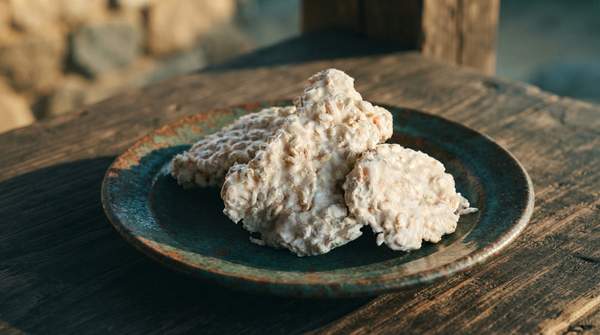
Rich, savory miso; deep, complex soy sauce; clean, fragrant sake — all three begin with the same quiet act of transformation. A mold, Aspergillus oryzae, is cultivated on grain, typically rice, where it secretes enzymes that dismantle the grain's own building blocks. Amylase breaks complex starches into simple sugars; protease breaks proteins into amino acids. Those two products — sweetness and umami's raw material — are the foundation of Japan's most iconic fermented foods, and the starting point for every fermentation that follows.
The Core Mechanism: Koji's Enzymatic Powerhouse
The mold at the center of this process has an official standing in its home country. In 2006, the Brewing Society of Japan certified koji as the nation's "national mold," describing it as "a valuable asset carefully nurtured and used by our ancestors," according to the food producer Marukome, whose site catalogs koji's uses and varieties. Yellow koji molds — Aspergillus oryzae and Aspergillus sojae — are the workhorses behind miso, soy sauce and refined sake.
Koji begins when spores of Aspergillus oryzae are introduced to steamed grain. As Adrienne Katz Kennedy reports in the food journal Sliced, the spores behave much like any fungus: given the right environmental conditions, they germinate and spread through the grain, forming a dense, white, fuzzy coating called mycelium. That coating is not decoration — it is where the mold deploys its toolkit. As it colonizes the grain, it releases amylase and protease, the two enzyme families that define everything koji can do. The mold, in effect, digests the grain from the outside in, converting stored starch and protein into forms that other organisms — including yeasts, bacteria and, ultimately, human diners — can use.
From Complex Grains to Simple Flavors: Sugars and Amino Acids
Each enzyme acts on a different substrate, and each product carries a different flavor destiny. Amylase targets carbohydrates: the long chains of starch locked inside rice, barley or soybeans are cleaved into simple sugars such as glucose. Protease performs the parallel operation on protein, breaking it down into its component amino acids. Marukome's primer on koji describes these paired actions as the essence of the mold's usefulness in traditional production.
What matters, according to a scientific review of koji fermentation published in the journal Microorganisms, is that these products are not single isolated chemicals but an entire profile of degradation compounds acting together. The review notes that while industrial amino acid and organic acid fermentations aim to produce one substance efficiently, fermented foods made with koji are evaluated on all of their degradation products at once. Glucose and amino acids produced by koji's enzymatic action directly shape the taste and flavor of the finished food — a point that explains why two batches of miso made from the same beans can taste profoundly different.
The review adds a further layer: some of those compounds continue reacting afterward. An amino-carbonyl reaction during storage, and oxidation-driven color changes, affect how a product looks as well as how it tastes. Koji's work, in other words, does not end when the enzymes stop; it sets off a chain of slower transformations that brewers and makers must anticipate.
Koji as a Foundation: Enabling Secondary Fermentations
The deeper reason koji matters so much is not just the flavor it creates directly, but the groundwork it lays for other microorganisms. The Microorganisms review is explicit on this point: the glucose and amino acids that koji releases serve as nutrients for yeast and lactic acid bacteria, and as the substrate for alcohol and lactic acid fermentation. Koji also produces small amounts of vitamins that act as growth-promoting factors for those microbes.
This is the structural insight that separates koji from a simple flavoring agent. In sake brewing, the grain cannot ferment itself — yeast consumes sugar, not raw starch. Someone must first convert that starch into sugar, and koji is the organism that performs that conversion. The same logic extends to miso and soy sauce, where the amino acids and sugars koji releases feed lactic acid bacteria and yeasts through long months of aging, building acidity, aroma and depth. Koji is the first domino: without its enzymatic breakdown, none of the subsequent fermentations that define these foods could proceed.
Tailoring Koji's Transformation: Sake, Miso, and Soy Sauce
The same mold, pointed at different substrates and different goals, produces remarkably different foods. The craft lies in which enzymatic pathway a maker emphasizes, and which microbes are invited in afterward.
Koji's Enzymatic Transformation: A Flavor Pathway
The framework below maps each enzymatic action to its chemical product, its flavor consequence, and its culinary destination. Reading it row by row shows why a single mold can yield both sweet and deeply savory outcomes depending on which substrate it is set to work on.
| Substrate | Enzyme | Primary Product | Flavor Contribution | Culinary Goal |
|---|---|---|---|---|
| Starch | Amylase | Simple sugars such as glucose | Sweetness; also feeds yeast | Alcohol production in sake |
| Protein | Protease | Amino acids | Umami and savory depth | Flavor development in miso and soy sauce |
The two rows are not rivals but collaborators, and their balance is the brewer's or maker's lever. In sake, the starch-to-sugar pathway dominates: rice is a starchy grain, and the glucose amylase releases becomes the fuel yeast converts into alcohol. In miso and soy sauce, protein takes center stage, because soybeans are protein-rich; the amino acids protease liberates are the building blocks of those foods' signature umami. And as the Microorganisms review emphasizes, the sugars and amino acids present in each case do double duty — they flavor the product directly while simultaneously feeding the yeasts and lactic acid bacteria that carry the fermentation through its later stages.
The practical consequence for anyone comparing these foods is that "koji" names a process, not a single taste. Kennedy, writing in Sliced, observes that virtually every culture that encounters koji or a food made from it becomes entranced by its transformative power — a sentiment echoed by Japan's decision to make the mold a national symbol. What entrances them is precisely the flexibility captured in the table: one organism, two enzymatic pathways, and an entire cuisine of outcomes.
Harnessing Koji: A Foundation for Culinary Innovation
The decision this understanding supports is simple: recognize koji's enzymatic activity as the fundamental driver of Japan's diverse fermented foods — the mechanism that both creates flavor directly and prepares the ground for yeast and lactic acid bacteria to finish the work. Whether the goal is the clean sweetness that becomes sake or the layered umami of miso and soy sauce, the process always runs through the same pair of enzymes acting on the same two substrates.
The measurable indicator to watch for is the presence of simple sugars and amino acids in a koji-fermented product — the direct evidence, per the Microorganisms review, that enzymatic breakdown has succeeded and that the product is ready either for further fermentation by other microbes or for consumption. Where those compounds appear, koji has done its work.